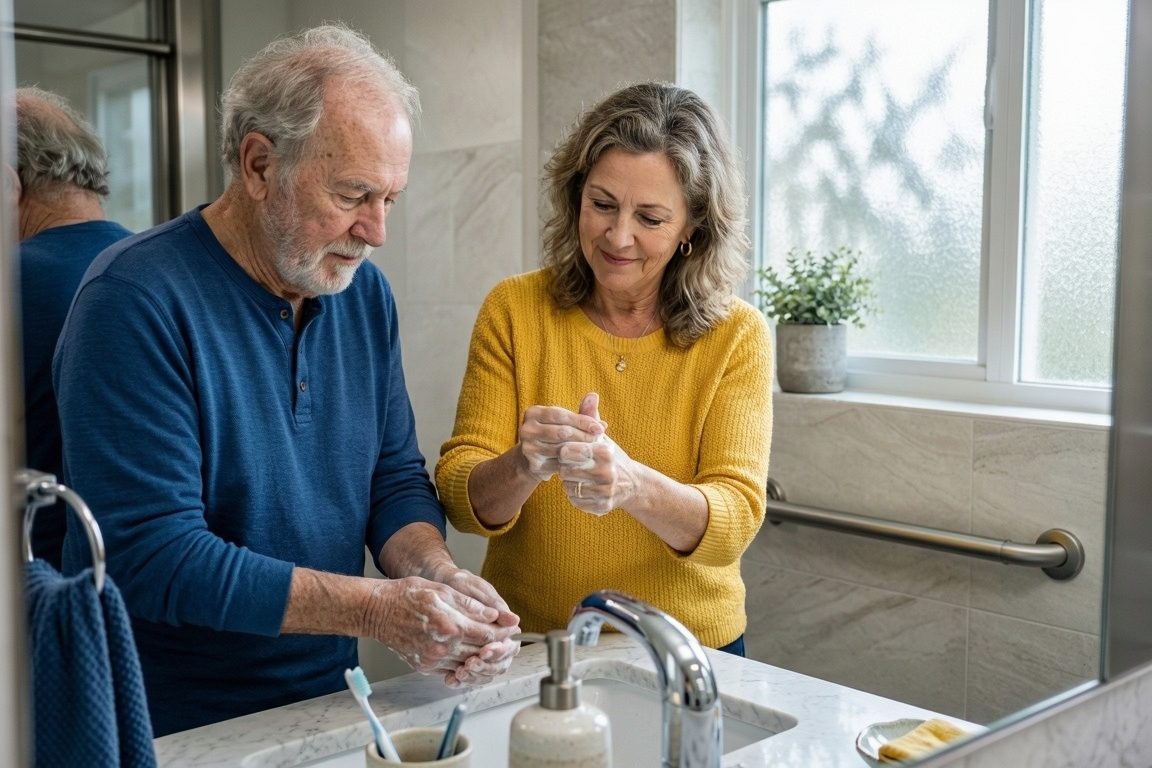
Step by step
What not to do
- Do not rush or scold. Rushing increases anxiety and can lead to aggression or shutdown.Instead, slow down, allow extra time, and use a calm voice. One expert warns that rushing 'creates anxiety for you and for them' and can cause them to 'push back and even shut down altogether.'
- Do not use harsh or strongly scented soaps. Many people with dementia become sensitive to smells, which can trigger agitation or nausea. Use mild, unscented soap and warm (not hot) water.
- Do not grab their hands without warning. Sudden touch can startle or feel threatening. Always announce what you're about to do: 'I'm going to help you wash your hands now. I'll start with your right hand.'
- Do not insist on a full 20-second scrub if they are distressed. Even a quick rinse with soap is better than nothing. You can try again later. The goal is cooperation, not perfection.
- Do not use complicated multi-step instructions. Break it down: 'First, wet your hands. Good. Now get soap.' Wait for each step to be completed before giving the next. This reduces confusion and frustration.
- Do not argue or correct if they say they already washed.Instead, say 'Oh, let's do a quick refresh together: I'll help you.' Arguing only escalates resistance. Redirect with a positive suggestion.
Key points
- The 20-second goal is about covering all hand surfaces, fronts, backs, between fingers, around thumbs, not a strict timer.
- Use the GEMS model to match your approach to the person's current abilities: Sapphire (reminder), Diamond (demonstration), Emerald (hand-over-hand), Amber (guided assistance), Ruby/Pearl (full assistance).
- Slow down and give one-step instructions. Rushing causes anxiety and resistance.
- Use music, a song, or a visual timer to make 20 seconds feel structured and less abstract.
- Give the person a 'job', holding a sponge or bar of soap, to engage them and reduce resistance.
- If they refuse, don't force. Try a different approach (washcloth, no-rinse foam) or try again later. Preserving dignity and trust is more important than a perfect wash.
Videos
 Wash Your Hands! Tips for Dementia Care PartnersThis video directly addresses the 20-second handwashing challenge with practical, stage-based strategies from Teepa Snow's Positive Approach to Care.
 How To Tell What Stage Of Alzheimer's Someone Is In?Helps you identify which GEMS stage your loved one is in, so you can apply the right handwashing approach.
 What to do when a person with dementia refuses care: 6 simple strategiesOffers gentle redirection techniques that are directly applicable when a person refuses handwashing.
 What are the different stages of dementia? The 3 stage and 7 stage models explainedProvides a clear overview of staging models, which complements the GEMS framework used in this article.
2 more videos
 Dementia Toileting problemsHandwashing after toileting is a common need, this video offers strategies for that specific context.
 What Are The 7 Stages Of Alzheimer's Disease? Stage 6Focuses on stage 6 (severe decline), which aligns with Amber/Ruby GEMS stages where handwashing requires full assistance.
Background
Why 20 Seconds Matters and What Dementia Changes
The 20-second rule isn't random, it's the time needed to mechanically remove germs from every hand surface. As one expert explains, the goal is to 'get the front sides, get both back sides, get between between, around around' so that all surfaces are covered. For a person with dementia, this sequence can become confusing, frightening, or physically impossible as the disease progresses. They may not understand why they need to wash, may forget the steps mid-way, or may feel the water temperature or texture of soap as threatening.
The GEMS Model: A Stage-by-Stage Lens
Teepa Snow's GEMS model categorizes dementia into six stages: Sapphire (early, independent), Diamond (mild changes, still functional), Emerald (moderate, needs cues), Amber (moderately severe, needs hands-on help), Ruby (severe, limited mobility), and Pearl (end-stage, full dependence). Each stage changes how you approach handwashing. In Sapphire, a simple reminder may suffice. By Amber, you may need to break the task into single steps and use hand-over-hand guidance. In Ruby and Pearl, you're doing most of the work while preserving dignity and comfort. Recognizing where your loved one is on this spectrum helps you adapt without frustration.
The Core Challenge: Processing Speed and Fear
People with dementia often have a 'latency' period, it takes longer for them to process a verbal request and respond. Rushing them creates anxiety for both of you and can lead to refusal or shutdown. Additionally, many develop depth perception problems, making stepping into a sink or under running water scary. They may also not perceive a need to wash or may find the experience cold and uncomfortable. The key is to slow down, use one-step-at-a-time instructions, and make the environment feel safe and familiar.
Practical tools
6
The 'Show and Tell' Script
Exact phrases to use: 'Watch me first: I'm putting soap on my hands. Now I'm rubbing the fronts. Now the backs. Now between my fingers. Now you try: I'll help.' Use a mirror if available so they can see their own hands. This leverages visual cues and reduces verbal load.
Handwashing Song Checklist
Print or write a simple 4-step checklist:
Post it near the sink with large, clear pictures. For non-readers, use icons (e.g., a picture of hands with arrows). This provides a visual cue that can be followed step-by-step.
The 'Job' Object
Give them a small, safe object to hold, a smooth stone, a soft sponge, or a bar of soap wrapped in a washcloth. Say 'Can you hold this for me while I help you wash?' This gives them a role and reduces resistance. One expert notes that 'giving them something to hold, something to look after for you' can be very effective.
No-Rinse Foaming Hand Soap
Products like 'No-Rinse Foaming Hand Wash' (available online) allow you to apply foam, rub, and wipe off with a towel, no sink needed. This is ideal for late stages or when water is frightening. Always test a small patch of skin first for sensitivity.
Warm, Soft Washcloths
Use a stack of pre-warmed, soft washcloths (damp with warm water and mild soap).
This avoids the sound and feel of running water, which can be startling. Keep them in a small insulated container to stay warm.
Timer with Visual Countdown
Use a simple kitchen timer or a visual timer app (e.g., 'Time Timer') that shows a red disk shrinking over 20 seconds. Say 'Let's watch the red go away while we wash, when it's gone, we're done!' This makes the time concrete and less abstract.
Different situations
Lewy body dementia (LBD) or Parkinson's disease dementia
People with LBD often have fluctuating attention, visual hallucinations, and sensitivity to water temperature. Use lukewarm water (test on your own wrist first). Avoid sudden movements or loud noises. If they see something in the water (a hallucination), calmly say 'I don't see it, but I'll help you wash anyway' and redirect. Keep sessions short (under 1 minute) and use a washcloth instead of running water.
Frontotemporal dementia (FTD)
FTD often affects behavior and impulse control more than memory. They may resist handwashing due to apathy or lack of concern. Use a firm but kind tone: 'We need to wash hands before lunch. I'll help you.' Offer a choice: 'Do you want to use the blue towel or the green one?' This gives a sense of control. Avoid reasoning or lengthy explanations.
Late-stage (Ruby/Pearl) / bedbound
You will do all the washing. Use a basin of warm water and soft cloths. Wash one hand at a time, supporting the wrist. Talk softly about what you're doing. Keep the person warm and covered. If they are in bed, use a waterproof pad under the hand. Focus on comfort and dignity, the 20-second goal is secondary to their peace.
Spouse vs. adult child caregiver
Spouses may find it emotionally harder to take on a 'parenting' role. Use the 'partner' language: 'Let's do this together.' Adult children may need to establish new authority, use a gentle but confident tone: 'Dad, I'm going to help you wash your hands now.' Both should avoid power struggles. If the person is more cooperative with a stranger (e.g., a home health aide), consider having that person assist.
In a facility or memory care
Coordinate with staff to use consistent cues and products. Provide a favorite towel or soap from home to create familiarity. If the person is agitated, staff may need to try later or use a different approach (e.g., a hand wipe). Share this guide with the care team so they understand the GEMS-based approach.
For the doctor
4
- If the person has skin conditions (eczema, psoriasis) or open wounds on hands, ask the doctor what soap and moisturizer are safe to use.
- If the person has a history of aspiration, avoid using running water near their face, use a basin instead. Ask the clinician about safe positioning.
- If the person becomes severely agitated or aggressive during handwashing, discuss with the doctor whether a medication adjustment or referral to a dementia specialist is appropriate.
- If the person has a latex allergy, ensure all gloves or washcloths are latex-free. Ask the clinician for a list of safe products.