Step by step
What not to do
- Do not accuse the person of 'faking it' or 'putting on a show' on purpose. This will cause shame and confusion. They cannot control this.Instead, say, 'I see you worked so hard to be with our guest. That must have been exhausting. Let's rest now.'
- Do not try to 'prove' to others that the person has dementia by pushing them into a stressful test. This can cause agitation and a crisis of trust.Instead, let the person have their good moment, and then share your log or video later.
- Do not assume that a good day means the dementia is 'not that bad.' Fluctuation is normal. A good day does not erase the struggles of the bad days. Plan for the worst, enjoy the best.
- Do not isolate yourself out of embarrassment. Join a caregiver support group (online or in person). Other caregivers will immediately understand this experience and can offer practical tips and emotional validation.
- Do not ignore a sudden, dramatic worsening that lasts more than a day. This could be delirium. Contact the doctor immediately and ask them to check for infection, medication changes, or dehydration.
Key points
- Showtime is a real symptom, not manipulation. The person is not in control of it.
- After showtime, expect a crash, exhaustion can last days. Plan for recovery.
- Fluctuating ability (good days/bad days) is normal. Sudden, dramatic worsening may be delirium, get medical help.
- You are not a fool. You are the person who sees the full picture. Trust your observations.
- Use tools like a log, video evidence, and a recovery plan to advocate for your person and protect your own sanity.
- Seek support from other caregivers, they will understand this experience immediately.
Videos
 What Is Showtime In Dementia?Directly defines showtime and explains why it is not intentional deception.
 This Is Dementia Happening Is Called 'Showtime'Shows the real-life impact of showtime on the person with dementia and the caregiver.
 Dementia Progression: What I Wish Caregivers Were ToldCovers fluctuating ability and the emotional toll on caregivers.
 Surprising Symptoms of Dementia: Part 1Explains that language abilities can remain intact even when other skills are lost, which contributes to showtime.


Background
What Is Showtime?
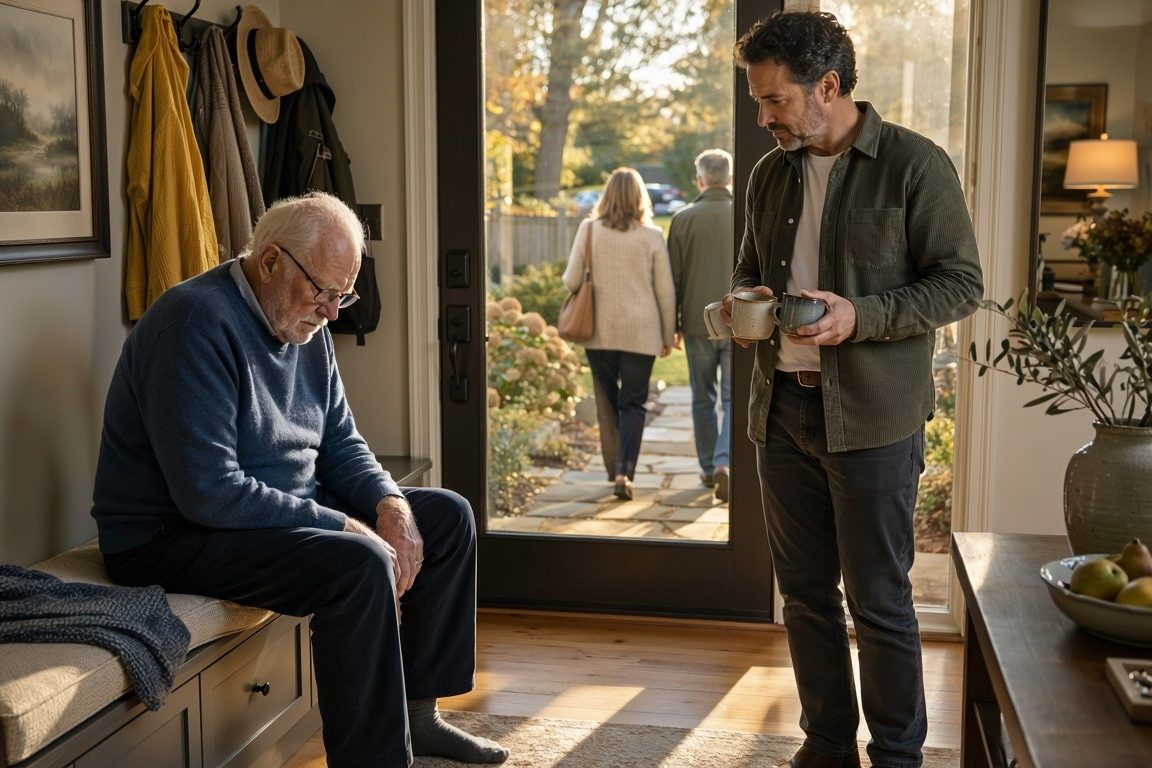
Showtime is when a person with dementia appears to be 'normal' or much more capable in front of others, doctors, friends, family who visit rarely , but then struggles significantly when alone with you. This is not a deliberate act of deception. It is a brain-driven survival strategy. The person is drawing on deeply ingrained social reflexes and stored routines that are still intact, even as other cognitive functions decline. They are not thinking, 'I will put on a show.' Their brain is automatically adapting to the environment and the social cues present. This is why a person who cannot remember what they ate for breakfast can still carry on a polite conversation with a guest for 20 minutes.
Why Does It Happen?
The brain of a person with dementia is constantly trying to compensate for damage. In a familiar, safe environment with you, the brain can relax its guard, and that is when the real struggles emerge. With strangers or in novel settings, the brain activates a kind of emergency performance mode. This is fueled by adrenaline and intense concentration, but it is not sustainable. After the visitor leaves or the doctor's appointment ends, the person crashes. They may be exhausted for days, sometimes over a week. This is not a sign that they are 'faking' with you. It is a sign that they trust you enough to let their guard down, and that they have spent all their energy pretending to be okay for others.
The Role of Fluctuating Ability and Delirium
Dementia itself is not a steady decline. People have good days and bad days, good hours and bad hours. This is called fluctuating ability. It is normal and expected. However, if you see a sudden, dramatic worsening over hours or a day or two, not the usual pattern , this could be delirium, a medical emergency often caused by infection (like a UTI), medication side effects, or dehydration. Delirium is different from dementia progression because it comes on fast and can be reversible if treated quickly. Always rule out delirium before assuming the dementia has simply progressed.
Practical tools
5
The 'Showtime Recovery' Plan
Create a simple written plan for after any visitor or appointment:
Post this where you can see it.
The 'One-Liner' for Skeptical Family
When a relative says, 'But she seemed fine to me,' respond calmly: 'I am so glad she had a good moment with you. Dementia is tricky, it comes and goes. The real challenges show up in daily life, and I am the one who sees them. I appreciate your support.'
The 'Good Day/Bad Day' Log
Keep a small notebook or a note on your phone. Each day, write one word: 'Good,' 'Fair,' or 'Bad.' Then note any possible triggers: 'Slept well,' 'Had a visitor,' 'New med,' 'Seemed restless.' Over two weeks, patterns will emerge that you can share with the doctor.
Video Evidence (with consent)
If you are comfortable and it is legal in your area, record a short (30-second) video of a typical struggle at home, e.g., your person asking the same question repeatedly, or being unable to find a familiar object. Show this to the doctor or care manager. It is worth a thousand words.
Environmental Cues for Better Function
Reduce clutter in the room where your person spends most time. Use labels on drawers and cupboards (e.g., 'Spoons,' 'Socks'). Keep a consistent routine for meals and sleep. Predictable environments reduce the need for the brain to 'perform' and can reduce showtime crashes.
Different situations
Lewy body dementia (LBD)
Fluctuations in cognition are often more extreme and rapid in LBD, good and bad can switch within hours. Visual hallucinations are also common. If your person seems to be 'seeing things' during a bad spell, do not argue. Instead, say, 'I see you are concerned. Let's move to a quieter room.' Always rule out delirium first, as LBD patients are highly sensitive to antipsychotic medications , discuss any new meds with the doctor.
Early-stage (mild) dementia
Showtime is most pronounced here because the person still has many social skills intact. They may be able to 'pass' in short conversations. Do not let this fool you into thinking they are fine. Use the 'good day/bad day' log and share it with the doctor. This is the best time to establish a care plan and legal documents, while the person can still participate.
Late-stage (severe) dementia
Showtime becomes less common because the brain can no longer sustain the effort. If your person suddenly seems 'better' after being very impaired, be suspicious of delirium or a medication effect. Contact the doctor. In late stage, focus on comfort, not performance. Do not push the person to 'perform' for visitors.
Spouse vs. adult child caregiver
Spouses often feel more personally rejected by showtime, as if the person is 'saving' their best for others. Adult children may feel undermined by siblings who say, 'Mom seems fine to me.' Both are painful. Spouses: remind yourself that your person trusts you most. Adult children: use the 'one-liner' tool above and invite the skeptical sibling to spend a full day with the person, not just a visit.
In a facility or with paid caregivers
Showtime can still happen. The person may seem more cooperative with staff than with you. This is normal. Do not take it personally. Ask the staff to note any changes in behavior after your visits, your person may be exhausted and need extra rest. Also, ensure the staff is trained to recognize showtime and not dismiss your concerns.
For the doctor
4
- If you notice a sudden, dramatic worsening over hours or a day or two, ask the doctor: 'Could this be delirium? Can we check for a urinary tract infection, medication side effects, or dehydration?'
- If your person is prescribed any new medication, especially an antipsychotic, ask: 'Is this safe for someone with Lewy body dementia or other dementia? What are the risks of side effects?'
- If the person has visual hallucinations that seem to distress them, ask: 'Could this be related to their dementia type? Are there non-medication strategies we can try first?'
- If you are struggling with the emotional impact of showtime, ask your doctor or a social worker: 'Are there caregiver support groups or counseling services you can recommend?'