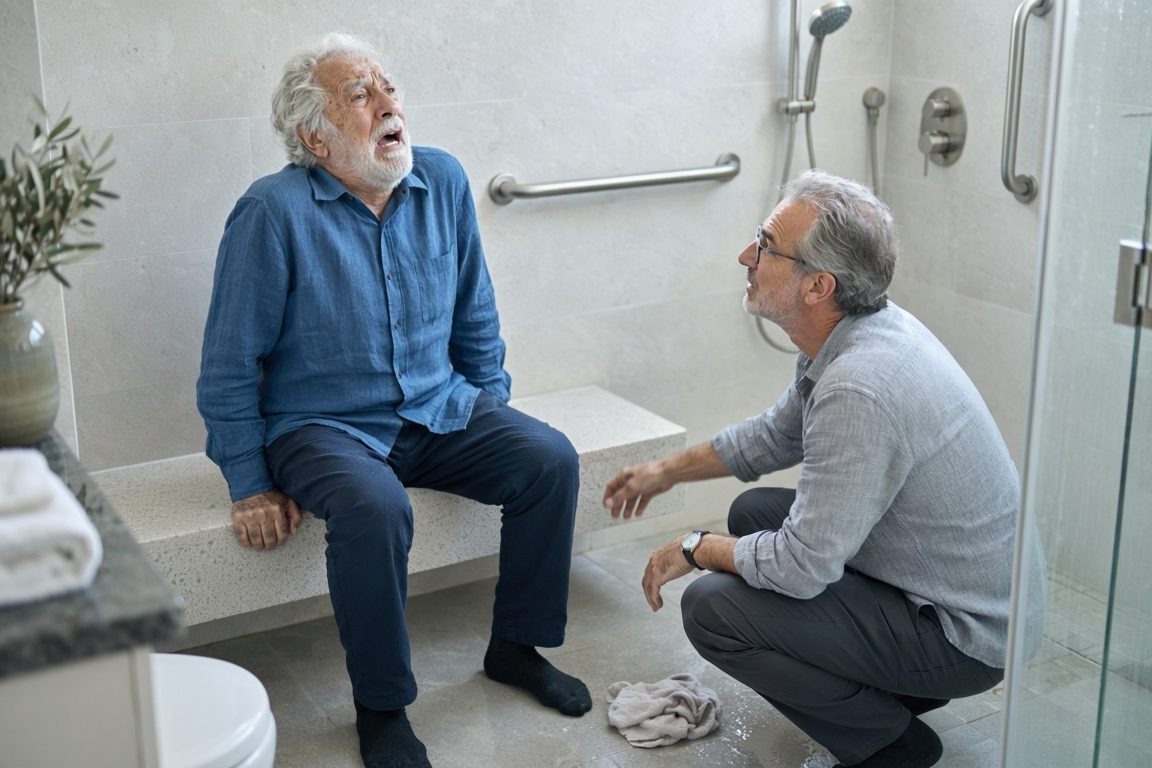
Step by step
What not to do
- Do not take it personally. The most common and damaging mistake is to feel attacked and react with hurt or anger. This escalates the situation and leaves you feeling guilty.Instead, repeat to yourself: 'This is a symptom, not a choice.'
- Do not try to reason or argue. Saying 'You know me, I'm your daughter, I'm not trying to hurt you' will not work. Their brain cannot process that logic. It will only frustrate them more.Instead, use simple, reassuring statements: 'I am here to help you.'
- Do not restrain them physically. Holding them down or grabbing their arms will make them fight harder and can cause injury to both of you. It also increases their fear and sense of being trapped.Instead, step back and give them space.
- Do not ignore the behavior or assume it is 'just the disease.' While it is a symptom, it is almost always a sign of an unmet need, often pain. Ignoring it means the underlying problem (like a urinary tract infection or a bedsore) will get worse. Always investigate.
- Do not raise your voice or use a harsh tone. This will only add to their fear and confusion. They may not understand your words, but they will pick up on your tone. Speak softly and slowly.
- Do not try to force care tasks when they are agitated. If they are hitting during bathing, stop. Trying to push through will only make the behavior worse and create a negative association with care. Come back later, try a different approach (like a sponge bath instead of a shower), or ask another caregiver to try.
Key points
- Screaming and hitting in late-stage dementia are distress signals, not personal attacks. They are the person's last way to say 'I am in pain, scared, or uncomfortable.'
- Pain is the number one cause. Always look for physical signs (wincing, guarding, flushed skin, fever) and use a pain assessment tool like PAINAD.
- Your calm, slow, low voice is your most powerful tool. Do not argue, reason, or raise your voice.
- Reduce environmental triggers: turn off the TV, dim lights, and remove extra people.
- Keep a behavior log for one week to identify patterns and share with the doctor.
- Take care of yourself. This is traumatic. Seek support from a helpline, support group, or respite care.
Videos
 Professional Alzheimer's & Dementia Training & TipsThis video directly explains that combative behavior is a desperate attempt to communicate pain or discomfort, not intentional harm. It is a core reframing tool for caregivers.
 What Stage of Alzheimer's is Anger?Helps you understand that anger and aggression are common in later stages and are linked to loss of control and frustration, not personal malice.
 Professional Alzheimer's And Dementia TrainingProvides practical, step-by-step training on how to respond to aggressive behaviors in a professional care setting, which is directly applicable to family caregivers.
 Aggressive Behavior in People with Dementia | Linda Ercoli, PhD | UCLAMDChatA geriatric psychologist explains the difference between agitation and aggression, and offers evidence-based strategies for managing these behaviors at home.
2 more videos
 Alzheimer's Disease - The End Stage (Mini-Series Part 3)Focuses specifically on the late-stage experience, including loss of communication and the need for comfort-focused care. Directly relevant to understanding the context of screaming/hitting.
 3 steps to change difficult dementia behaviorsOffers a simple, memorable three-step framework for responding to upset, yelling, or anxious behavior, which is exactly the scenario described in this article.
Background
What Is Really Happening: The Brain's Last Alarm System
In late-stage dementia, the brain's frontal lobes, which normally help us control impulses, understand our own limitations, and use language , are severely damaged. Your loved one has lost the ability to say 'I'm in pain,' 'I'm scared,' or 'I need to use the bathroom.' Instead, that urgent need erupts as a scream, a swat, or a bite. This is not anger or malice; it is a primal, desperate attempt to communicate. The harder they fight, the more intense their distress. Think of it as a fire alarm: you don't get angry at the alarm, you look for the fire. The 'fire' could be physical pain (like an undetected infection, constipation, or a bedsore), overwhelming fear (from not recognizing their surroundings or you), or profound discomfort (being too hot, too cold, or needing to move).
Why It Feels So Personal (And Why It Isn't)
It is completely natural to feel hurt, frightened, or even angry when someone you love screams at you or tries to hit you. But remember: the person with dementia is not choosing this behavior. Their brain is broken, and the part that would normally let them say 'I'm sorry, I didn't mean that' is gone. The aggression is a symptom of the disease, just like a runny nose is a symptom of a cold. Taking it personally will only add to your own distress and make it harder to respond calmly. The most powerful shift you can make is to see the behavior as a problem to be solved, not a person to be fought. Your job is to become a detective, not a defender.
Common Triggers in Late-Stage Dementia
In late-stage dementia, the triggers for screaming and hitting are almost always physical or environmental. Pain is the number one cause, but it is often hidden because the person cannot tell you where it hurts. Look for signs like wincing, guarding a body part, pale or flushed skin, dry gums, vomiting, fever, or swelling. Other common triggers include: being hungry or thirsty, needing to use the toilet, feeling too hot or cold, being in an unfamiliar or overstimulating environment (loud noises, bright lights, too many people), or feeling trapped during care tasks like bathing or dressing. Sometimes the trigger is as simple as being tired, dementia symptoms often worsen in the evening (a phenomenon called 'sundowning').
Practical tools
6
The PAINAD Scale (Pain Assessment in Advanced Dementia)
A simple 0-10 scale you can use to assess pain in someone who cannot speak. It looks at five areas:
Print a copy and keep it with you. Share your scores with the doctor.
The 'Stop, Look, Listen' Checklist
When screaming or hitting starts, run through this mental checklist:
Calming Phrases to Say (Exact Words)
Use these phrases in a low, slow, gentle voice: 'I am here. You are safe.' 'I want to help you. Tell me what you need.' 'Let's take a deep breath together.' 'I see you are upset. I am going to help you feel better.' 'Would you like a drink of water?' 'Let's sit down for a moment.' Avoid questions that start with 'why.'
Sensory Calming Kit
Prepare a small basket with items that soothe the senses:
Offer one item at a time during an agitated moment.
The Behavior Log Template
Keep a simple notebook or use a notes app. For each episode, write: Date and time. What happened right before (the trigger). What the behavior looked like (screaming, hitting, biting). What you did. What helped (or didn't). Any physical signs you noticed. After a week, look for patterns. This is gold for the doctor.
The 'Two-Minute Timeout' for the Caregiver
If you feel yourself getting angry, scared, or overwhelmed, it is okay to step away for two minutes, as long as the person is safe. Go to another room, take five deep breaths, splash water on your face, or call a friend. You cannot help them if you are flooded with emotion. Set a timer, then return with a calm face and voice.
Different situations
Lewy Body Dementia (LBD) or Parkinson's Disease Dementia
In these types, visual hallucinations and paranoia are very common. Screaming or hitting may be a reaction to seeing something frightening (like a stranger or an animal) that is not real. Do not argue about the hallucination. Instead, acknowledge their fear: 'I see you are scared. I will keep you safe.' Then try to redirect to a calming activity. Also, people with LBD can have extreme sensitivity to medications (neuroleptic sensitivity), so any new medication for agitation must be discussed very carefully with a specialist.
Spouse vs. Adult Child Caregiver
Spouses often feel a deeper sense of personal betrayal when their partner hits them. It can feel like a loss of the marriage itself. It is crucial for spouses to get their own emotional support, through a support group, counseling, or talking to a friend. Adult children may feel guilty or resentful. Both roles need to remember: the behavior is not personal. If the person is most aggressive with one caregiver (often the primary one), it may be helpful to have a second person (another family member or paid aide) handle certain care tasks like bathing or dressing.
In a Facility (Nursing Home or Memory Care)
If your loved one is in a facility, screaming or hitting may be a sign that their needs are not being met. Ask the staff to use the PAINAD scale and to keep a behavior log. You may need to advocate for a doctor's visit to rule out a hidden infection. Also, check if the environment is overstimulating (loud, bright, chaotic) or understimulating (boring, lonely). Ask if they can have more one-on-one time with a staff member or volunteer. If the behavior is severe, the facility may request a geriatric psychiatry consult.
Medicaid or Limited Resources
If you cannot afford paid caregivers or special products, focus on free or low-cost strategies: use a calm voice, reduce noise and light, offer a familiar object (a photo, a stuffed animal, a favorite blanket), and keep a simple behavior log on paper. Call your local Area Agency on Aging or Alzheimer's Association helpline (800-272-3900) for free support and resources. Respite care may be available through Medicaid waivers or local nonprofits.
For the doctor
5
- If the behavior is new, sudden, or severe, ask the doctor: 'Could this be a urinary tract infection, pneumonia, or another acute medical problem?'
- Ask: 'Should we consider a pain medication trial to see if the behavior improves?'
- If the person is hitting or screaming frequently, ask: 'Is there a medication that might help reduce agitation without causing too many side effects?' Be sure to mention any history of Lewy body dementia or Parkinson's, as some medications can be dangerous.
- Ask: 'Can a geriatric psychiatrist or a geropsychologist evaluate my loved one to help us find non-medication strategies?'
- If the person is in a facility, ask: 'What is your protocol for assessing pain in non-verbal residents? Can you show me how you use the PAINAD scale?'