Step by step
What not to do
- Do not correct them when they misidentify someone. Correction makes them feel ashamed; instead, join their reality, 'Oh, you mean the one with the curly hair? Yes, she's wonderful.'
- Do not talk about them in the third person as if they are already gone. Speak directly to them, use their name, and assume they can understand more than they can express.
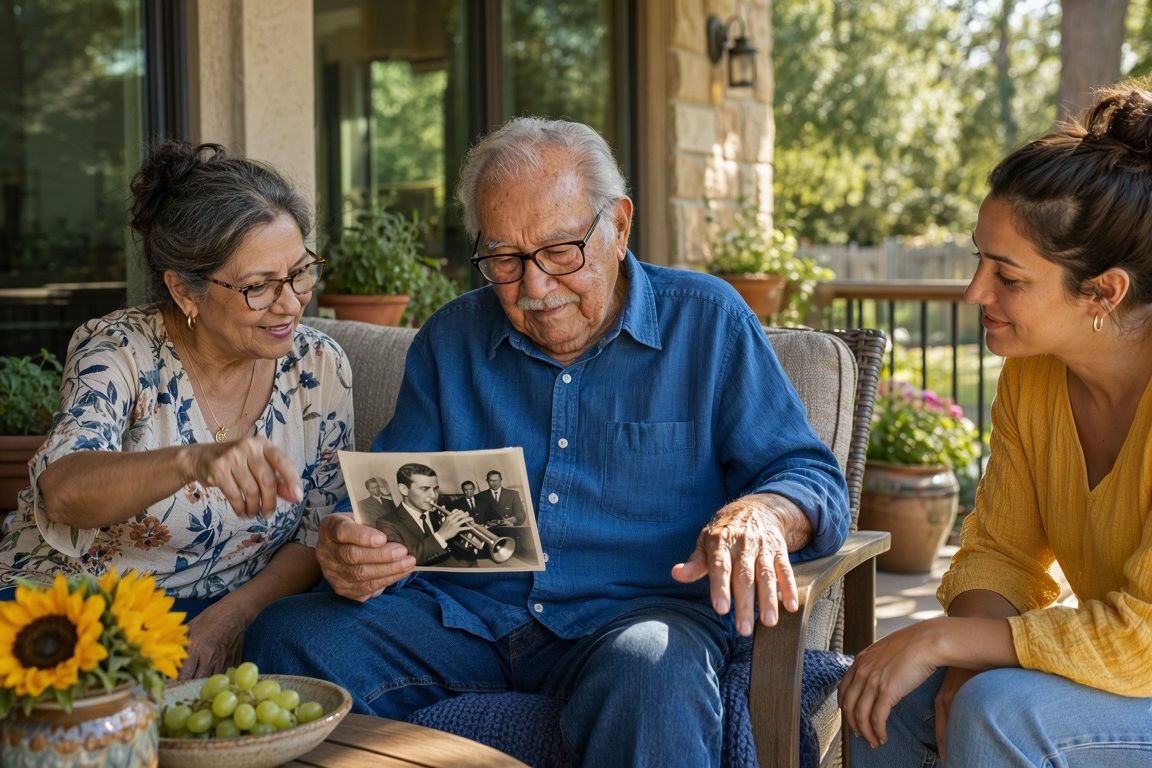
- Do not force them into your reality with questions like 'Don't you remember?' This highlights loss.Instead, use photos as a starting point for your own storytelling, not a quiz.
- Do not argue or try to reason them out of a false belief. Logic will not win, and the argument will cause distress. Acknowledge their feeling, gently redirect, and save energy for connection.
- Do not assume that because they cannot do something today, they never will again. Abilities fluctuate with stress or time of day, try again later with a different cue or environment.
Key points
- Dementia changes how a person sees the world, they see in snapshots, not a fluid movie. Adjust the environment to reduce visual confusion.
- The person is still whole and valuable. Their worth does not depend on their memory or abilities.
- Use 'both/and' thinking instead of all-or-nothing thinking to reduce your own stress and stay connected.
- Cue instead of do, give a verbal or visual prompt before taking over a task. This preserves their dignity and skill.
- Create 'social success' moments every day to help them feel they have something to offer.
- Take care of yourself. You cannot see the whole person in your loved one if you are exhausted and isolated.
Videos
 Jill Couch DAWN Dementia SpecialistThis video explains how to shift the caregiver relationship from 'I have to take care of you' to 'we are family' using the DAWN method. It gives practical tools for preserving the person's sense of self and value.
 How Can You Tell The Difference Between Confusion And Dementia?This video helps you distinguish between normal confusion (which can be addressed) and dementia-related changes. Understanding this difference helps you respond with patience instead of frustration.
 What Is The Difference Between Confusion And Dementia?A companion video that deepens your understanding of how dementia affects perception and why your loved one's behavior is not a choice but a brain change.
 Two Kinds of Vision That All Humans HaveTeepa Snow explains protective vs. non-protective vision and how dementia changes what a person sees. This is crucial for understanding why your loved one may seem fearful or confused in certain environments.
2 more videos
 Ep. 279: How much is 94 Years Worth?This episode explores the value of a long life and how to honor a person's history even when their memory fades. It offers emotional support for caregivers struggling with grief.
 Balancing your life as a dementia caregiver: How to be a caregiver AND still live a life you likeThis video gives concrete strategies for maintaining your own identity and well-being while caregiving. It reinforces that you cannot see the whole person in your loved one if you lose yourself.
Background
Dementia Changes More Than Memory: It Changes How the Person Sees the World
Most people think dementia is just about forgetting names or losing keys. But it affects every part of the brain, including vision, hearing, and how the person interprets their surroundings. A person with dementia does not see the world as a smooth, flowing movie like you do. Instead, they see it in snapshots, like a series of still pictures. This means they can miss a car moving toward them, not recognize a familiar face, or misinterpret a pattern on a rug as a hole or a stain. When you understand this, you realize that their confusion or fear is not a sign of being 'lost' , it is a sign that their brain is working hard to make sense of a world that no longer looks or sounds the same.
The Person Is Still There: Their Abilities Are Just Changing
Even in the deepest stages of dementia, the person retains a sense of self, a need for connection, and the ability to experience joy, beauty, and value. The problem is that our culture teaches us to measure a person by what they can do, remember, plan, speak clearly. When those abilities fade, we mistakenly think the person has faded too. But dementia does not erase a person's worth or their history. It just changes how they express themselves and how they need to be supported. The goal is not to fix them, but to shift the relationship from 'I have to take care of you' to 'we are family, and we will find new ways to be together.'
Your Own Brain Can Get Stuck in All-or-Nothing Thinking
Caregivers often fall into a trap of absolute thinking: 'He is either here or gone.' 'She is either present or absent.' 'I am either a good caregiver or a failure.' This black-and-white thinking creates stress and makes it harder to see the whole person. The more helpful mindset is 'both/and' thinking: your loved one is both here and sometimes gone; they are both present and sometimes absent; you are both a good caregiver and sometimes you could do better. This shift lowers your stress and opens your brain to creative solutions. When you stop demanding perfection from yourself and from your loved one, you can actually see the person who is still there.
Practical tools
4
The 'Both/And' Mantra
When stuck in all-or-nothing thinking, say: 'My loved one is both here and sometimes gone. I am both a good caregiver and sometimes I could do better. We are both struggling and still connected.' Repeat three times to lower stress and open creative solutions.
The 'Cue Instead of Do' Checklist
Before stepping in, ask: '
' For example, hand them a napkin and say 'Here you go' instead of wiping their mouth. This preserves agency and skill.
The 'Social Success' Script
When a visitor comes, say: 'Mom, this is my friend Sarah. Sarah loves gardening, just like you used to. Can you tell her about the roses you grew?' If your loved one cannot answer, fill in the story yourself, the goal is contribution, not memory.
Vision-Friendly Environment Checklist
Monthly, check each room for:
This prevents falls and fear.
Different situations
Lewy body dementia (LBD)
In LBD, visual hallucinations and delusions are common. A person might see something that is not there (like a person or animal) or misinterpret a pattern as something threatening (like seeing blood on a red gown). Do not argue with the hallucination. Instead, acknowledge their feeling: 'That must be scary. I am here with you.' Then gently redirect: 'Let's go sit in the other room where it's quieter.' Also, watch for sudden changes in alertness or falls, and discuss any medication reactions with the doctor, people with LBD can have severe reactions to certain antipsychotics.
Late-stage dementia
In late stages, the person may not recognize you or speak. But they can still feel your presence, your tone, and your touch. Focus on sensory comforts: play their favorite music, hold their hand, use a soft blanket, or offer a familiar scent. Speak in a calm, warm voice even if they do not respond. Use simple, one-step directions: 'Open your mouth' or 'Squeeze my hand.' The goal is not conversation, but connection. You can still see them as whole by honoring their need for comfort and dignity.
Spouse vs. adult child caregiver
If you are a spouse, you may feel the loss of your partner more acutely, the person who shared your history, your bed, your dreams. Allow yourself to grieve the loss of that relationship while also finding new ways to connect. Use 'both/and' thinking: 'He is both my husband and someone who needs different care now.' If you are an adult child, you may struggle with role reversal. Remind yourself: 'She is still my mother, even if I am helping her with bathing.' Use reminiscing to honor her past role: 'Mom, you always made the best apple pie. Can you tell me about it?' This preserves the parent-child bond even as care needs shift.
Living in a facility
When your loved one is in a facility, you may feel like you have lost your role. But you are still their primary connection to their history and identity. Visit with a specific purpose: bring a photo album, a favorite song, or a familiar scent. Talk to the staff about their life story, what they loved, what they feared, what made them laugh. Ask staff to use the same cues and phrases you use. You can also advocate for a 'dementia-friendly' environment: ask for high-contrast signs, reduced clutter, and consistent routines. Your presence and advocacy help the staff see your loved one as a whole person, not just a patient.
Early-stage dementia
In early stages, the person is often aware of their losses and may feel frustrated, angry, or depressed. Do not minimize their experience. Instead, validate their feelings: 'I know this is hard. You are still you, and I am here with you.' Use the 'social success' tool to help them feel capable: ask them to help with simple tasks like folding napkins or sorting photos. Encourage them to fill out a 'life story' document or a 'This Is My Life' booklet while they can still contribute. This preserves their sense of identity and gives you a tool for later reminiscing.
For the doctor
4
- If your loved one is experiencing hallucinations or delusions that are frightening or causing them distress, ask the doctor about possible medication adjustments or non-drug approaches.
- If your loved one has a sudden change in vision or starts seeing things that are not there, ask the doctor to rule out delirium, infection, or medication side effects.
- If you are feeling overwhelmed, depressed, or unable to cope, ask your own doctor about caregiver support resources, counseling, or respite care options.
- If your loved one is in late stages and you are considering hospice or palliative care, ask the doctor about how to adjust medications to prioritize comfort and quality of life.