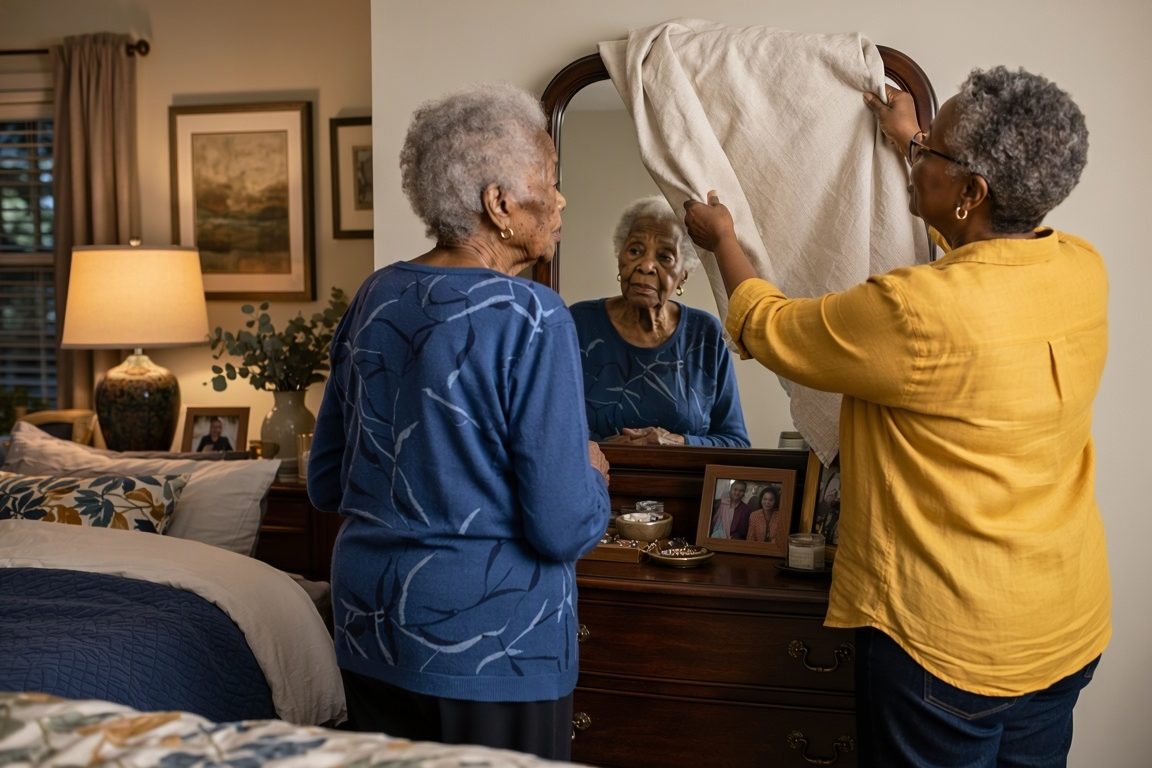
Step by step
What not to do
- Do not argue or try to convince the person that what they see is not real; validate the feeling and redirect instead.
- Do not force the person to look at their reflection or explain who it is; simply cover the mirror and avoid drawing attention.
- Do not use TV as a distractor during care tasks like bathing or eating; use calm, instrumental music instead.
Key points
- Mirror and TV confusion is a brain-based perceptual problem, not a behavioral choice. Respond with patience, not argument.
- Cover or remove mirrors and turn off the TV when not actively watching. This is the most effective intervention.
- Use good lighting to reduce shadows and prevent confusion, especially in the late afternoon and evening.
- Distract and redirect gently when confusion occurs. Offer a walk, a snack, or a calming activity.
- Create a calm, low-stimulation environment with consistent routines to reduce overall confusion.
- If confusion is sudden or severe, rule out medical causes like infection or medication side effects by consulting a clinician.
Videos
 Why Mirrors Confuse People with Dementia (And How to Fix It!)This video directly explains why mirrors cause distress and offers practical covering and redirection strategies.
 Dementia Paranoia Explained: Why It Happens & How to RespondThis video helps you understand paranoia that can arise from mirror or TV confusion, and how to respond without arguing.
 Why does Dementia Sometimes Cause Hallucinations, Delusions, and Paranoia w/ Lucy Barylak Dec 14 23This video covers the broader topic of hallucinations and delusions, which often include mirror and TV confusion.
 What Is Sundowning In Dementia And How To Cope? - Dementia Help HubSundowning often worsens mirror and TV confusion; this video gives practical coping strategies for late afternoon and evening.
2 more videos


Background
Why mirrors and TV cause confusion
When dementia affects the parts of the brain responsible for perception and memory, a person may literally not recognize their own reflection. They might see a stranger in the mirror and feel frightened or threatened. This is not stubbornness or confusion about identity in a symbolic sense; it is a genuine perceptual problem. The brain is no longer able to correctly interpret the image as a reflection of themselves, so it creates a story that makes sense to it, often that a stranger is present. This can be especially distressing if the person already feels vulnerable or unsafe in their environment.
The same issue applies to TV and video calls
A similar confusion happens with television, computer screens, or video calls. The person with dementia may not grasp that the people on the screen are far away and not actually in the room. They might try to shake hands with someone on a video call or talk to a news anchor as if they are a guest. This can be unsettling for them and for you. It is not a sign of worsening dementia in itself, but a symptom of how the brain is processing visual information. Recognizing this as a brain-based issue, not a behavioral choice, is the first step to responding with patience and effectiveness.
How this connects to sundowning and overstimulation
Confusion from mirrors and TV often worsens in the late afternoon or evening, a phenomenon known as sundowning. As daylight fades, shadows lengthen and the brain has a harder time interpreting the environment. Poor lighting can make reflections and screen images even more confusing. Additionally, a cluttered or noisy environment with multiple sounds (TV, radio, conversations) can overwhelm the brain, leading to agitation or anxiety. The person may not be able to tell you they feel overwhelmed; instead, they may become restless, pace, or react fearfully to what they see.
Practical tools
5
Mirror cover or removable film
Use removable, non-adhesive window film, a cloth drape, or a pull-down shade mounted above the mirror to allow uncovering for grooming but keep it covered otherwise.
Calming music playlist
Create a playlist of the person's favorite instrumental or simple melodies from their younger years to use instead of TV for background sound.
Redirection script
Practice phrases like 'I see you are worried about that person. Let's go look out the window together' or 'That TV show is confusing. How about we listen to some music?'
Lighting checklist
At key times:
TV cover or framed art screen
When TV is not in use, place a framed picture, sliding art panel, or fabric cover over the screen to make it blend into the room as decor.
Different situations
Lewy body dementia or Parkinson's disease dementia
These conditions often involve visual hallucinations and paranoia. Mirror and TV confusion may be more intense and frequent. Be extra vigilant about covering reflective surfaces and turning off screens. Also, ensure the person is evaluated for any underlying medical issues (like a urinary tract infection) that can worsen hallucinations. Consistency in where items are placed (e.g., glasses always on the same spot) can reduce paranoia about missing or stolen objects.
Late-stage dementia
In advanced stages, the person may not be able to communicate distress verbally. Watch for nonverbal cues like turning away from a mirror, covering their eyes, or becoming agitated when near a TV. In these cases, simply remove all mirrors and screens from the immediate environment. Use soft, indirect lighting and calming music. The goal is to minimize any potential trigger.
Spouse vs. adult child caregiver
A spouse may feel more comfortable making changes to the home, but may also struggle with the emotional weight of covering a mirror that holds memories. An adult child might need to negotiate with a parent who is still living independently. In either case, involve the person with dementia in the decision if possible, and frame changes as 'making things more comfortable' rather than 'fixing a problem.'
In a care facility
In a facility, you may need to work with staff to cover mirrors or adjust TV placement. Bring your own mirror cover or request that the TV be turned off during certain times. Advocate for a consistent routine and good lighting, especially in the late afternoon. If the person shares a room, coordinate with the roommate's family to ensure a calm environment.
Early-stage dementia with insight
If the person is still aware of their diagnosis and can understand the reasoning, you can have a gentle conversation: 'I read that mirrors can sometimes be confusing for people with memory changes. Would you like to try covering this one for a while and see if it feels better?' This collaborative approach can empower them and reduce resistance.
For the doctor
4
- If mirror or TV confusion is accompanied by sudden, severe agitation, hallucinations, or paranoia that lasts for hours, ask the doctor: 'Could this be delirium caused by an infection, medication side effect, or other medical issue?'
- If the person is taking medications that list hallucinations or confusion as a side effect, ask the pharmacist or doctor: 'Could this medication be contributing to the visual confusion?'
- If the confusion is causing the person to become physically aggressive or to try to leave the house, ask the doctor: 'Are there any non-drug approaches or, if needed, medications that could help reduce this distress?'
- If the person has a history of falls and you are covering mirrors or changing lighting, ask the doctor or occupational therapist: 'Are there any safety concerns I should consider with these environmental changes?'