Step by step
What not to do
- Do not force a child to spend time with a grandparent who is agitated or aggressive. This can frighten the child and create negative associations.Instead, wait until the grandparent is calm, and keep visits short. If the grandparent is having a bad day, reschedule. Your child's emotional safety comes first.
- Do not hide the diagnosis from your children. They will notice changes anyway, and secrecy can make them imagine something worse. Use age-appropriate language. For a young child, say, 'Grandma's brain has a sickness that makes her forget.' For a teenager, you can explain more: 'It's Alzheimer's, and it will get worse over time. We will face it together.'
- Do not expect your children to take on adult-level responsibilities. A 10-year-old should not be left alone to manage a wandering grandparent or to handle toileting. That is your job or a paid caregiver's job. Children can help with companionship and simple tasks, but they are not substitute caregivers. Overburdening them can lead to resentment and burnout.
- Do not compare your children to each other or to other kids. One child may be naturally nurturing; another may be more reserved. Both are okay. Let each child contribute in their own way. Forcing a child to do something they are uncomfortable with can backfire.Instead, offer choices: 'Would you rather read to Grandma or help me make her lunch?'
- Do not neglect your own self-care. You cannot pour from an empty cup. If you are exhausted and stressed, your children will feel it. Take 15 minutes a day for yourself, a walk, a cup of tea, a call to a friend. Model healthy boundaries for your children. As one expert said, 'Start taking better care of yourself today, no matter your health situation.'
Key points
- Involving children in dementia caregiving teaches empathy, patience, and life skills that schools don't teach.
- Match tasks to the child's age and the grandparent's stage of Alzheimer's. Keep it simple and safe.
- Talk openly with your children about the diagnosis. Use age-appropriate language and validate their feelings.
- Use tools like the 'Grandma Helper' chart, the 'Calm Down' script, and the 'One Thing' rule to make involvement manageable.
- Protect your relationship with your children by scheduling regular one-on-one time away from caregiving.
- Take care of yourself. You cannot pour from an empty cup. Seek support from family, friends, or a caregiver support group.
Videos
 Being a Working Caregiver in the Sandwich GenerationThis video directly addresses the challenges of balancing work, children, and aging parents, offering practical time-management tips.
 Are You Part of the Sandwich Caregiver Generation?This video explains the statistics and emotional reality of being sandwiched, helping you feel less alone and more understood.
 An Interview with Denise Brown the Founder at The Caregiving Years AcademyDenise Brown shares wisdom on how to involve family members of all ages in caregiving, including children, with a focus on sustainability.
 The Realities of CaregivingThis video covers the day-to-day realities of caregiving, including how to manage the emotional toll on children and yourself.
2 more videos
 Paul Wynn Journalist & Co-Author of 'The Caregiver's Advocate Vol. 2'Paul Wynn offers insights on advocating for your family's needs, including how to ask for help and set boundaries with children involved.
 162. National Caregiver Month: Data and caregiver tips from The Alzheimer's AssociationThis video provides data-driven tips from the Alzheimer's Association, including how to communicate with children about the disease.
Background
What Is the Sandwich Generation and Why Does It Matter for Dementia Care?
The sandwich generation describes adults who are simultaneously raising their own children and caring for aging parents. According to the U.S. Census Bureau, between 2024 and 2030, 10,000 adults will turn 65 every single day. Among Americans in their 40s, over half, 54 percent, are currently sandwiched between an aging parent and their own children. By the time these adults reach their 50s, nearly 60 percent have helped an aging parent financially. This dual role is especially complex when the parent has Alzheimer's disease, because the care needs are unpredictable, emotionally draining, and often require round-the-clock attention.
Why Involving Your Children Helps Everyone
When you involve your children in caring for a grandparent with dementia, you are not just getting extra hands, you are teaching them life skills that schools often skip. As one expert noted, children who learn these interpersonal skills early develop 'ingrained interpersonal skills' that serve them for life. They learn that aging is not something to fear, and they see firsthand how to be patient, kind, and resourceful. For you, the caregiver, sharing tasks reduces your burden and gives you moments to breathe. For your parent with Alzheimer's, time with grandchildren can bring joy, stimulation, and a sense of purpose. The key is to match tasks to the child's age and the grandparent's current abilities, and to keep communication open and honest.
The Emotional Reality: Your Children Notice Everything
Children are perceptive. They notice when Grandma says something odd, when you seem more stressed, or when the usual routines change. If you don't talk to them about what is happening, they may fill in the gaps with fear or confusion. Experts recommend using your discretion about how much detail you share, but letting them know that their grandparent has a condition that requires extra help and sometimes causes unusual behavior. Keep an open dialogue. Ask them what they notice and how they feel. This prevents them from feeling left out or scared, and it builds trust. At the same time, be honest with yourself: you cannot heal your parent or convince them to do things they don't want to do. You can only control your own actions and your children's understanding.
Practical tools
6
The 'Grandma Helper' Chart
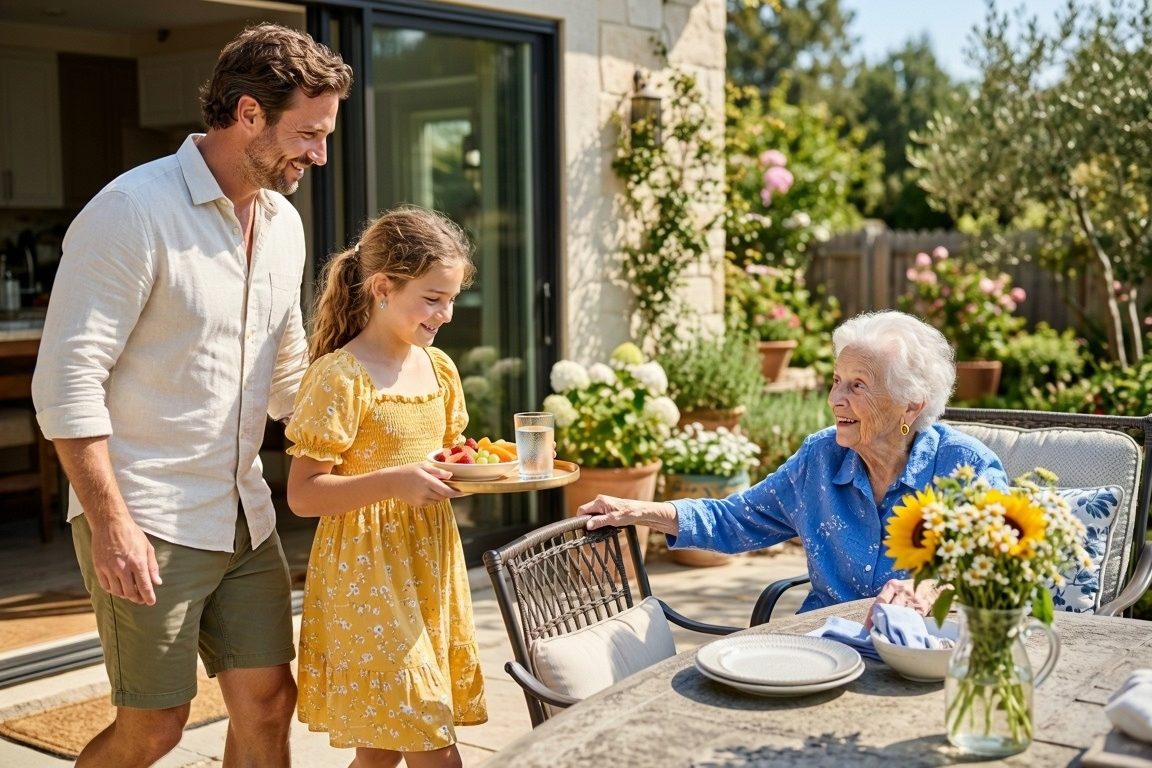
A simple visual chart on the fridge or a whiteboard. List 3–5 tasks your child can do, such as: 'Bring Grandma a snack,' 'Read a short book,' 'Hold her hand during a walk,' 'Sing a song,' or 'Help set the table.' Let your child check off each task. This gives them ownership and a sense of accomplishment. For younger children, use stickers. For older children, let them choose the order of tasks.
The 'Calm Down' Script for Children
Teach your child these exact phrases to use when Grandma is confused or upset: 'You are safe here with us.' 'Let's look at this photo album together.' 'Would you like a hug?' 'I will go get Mom/Dad.' Role-play these phrases so your child feels prepared. Remind them: 'Never argue with Grandma about what is real. Just comfort her and come get me.'
The 'Memory Box' Activity
Create a small box or bag with items that are meaningful to your parent:
Let your child help choose and arrange the items. When your parent is restless or anxious, your child can bring the box and say, 'Look what I found, Grandma. Do you remember this?' This gives the child a concrete tool to connect and comfort.
The 'One Thing' Rule
Each time your child visits or helps, ask them to do just one thing. For example: 'Today, your one thing is to bring Grandma a cup of tea.' Or 'Your one thing is to show her your new drawing.' This prevents overwhelm and makes the interaction feel manageable. After they do their one thing, they can go play or do homework. This respects their time and energy.
The 'Caregiver Break' Timer
Set a timer for 15–30 minutes when your child is helping. Use that time to do something for yourself: take a shower, make a phone call, or just sit quietly. Tell your child, 'I am going to take a break now. You are in charge of keeping Grandma company until the timer goes off. If you need me, come get me.' This teaches responsibility and gives you a real break.
The 'Feelings Check-In'
Once a week, sit down with your child and ask: '
' Listen without judgment. If your child expresses sadness or frustration, validate it: 'It is okay to feel that way. This is hard for all of us.' This keeps communication open and prevents bottled-up emotions.
Different situations
Alzheimer's early stage (mild cognitive decline)
In early-stage Alzheimer's, your parent may still recognize grandchildren and enjoy interactive activities like simple card games, looking at photo albums, or short walks. Involve children in these activities. Teach your child to ask open-ended questions like, 'What do you remember about this picture?' rather than 'Do you remember this?' This respects your parent's remaining abilities and keeps interactions positive.
Alzheimer's middle stage (moderate decline)
At this stage, your parent may have trouble with conversation and may become easily agitated. Keep tasks very simple: holding hands, listening to music together, or folding laundry side by side. Use the 'Calm Down' script frequently. Your child should never be left alone with your parent for more than 5–10 minutes. The focus shifts from conversation to companionship and sensory activities.
Alzheimer's late stage (severe decline)
In late-stage Alzheimer's, your parent may be bedridden or non-verbal. Involve children in gentle sensory activities: playing soft music, applying lotion to hands, or simply sitting nearby and talking softly. Explain to your child that Grandma may not be able to talk back, but she can still feel love. This teaches compassion and acceptance of end-of-life realities.
You are a single parent or the only caregiver
If you are doing this alone, your children may need to take on slightly more responsibility, but be careful not to overload them. Use the 'One Thing' rule strictly. Enlist help from extended family, neighbors, or a paid caregiver for at least a few hours a week so you can have one-on-one time with your children. Consider joining a support group for sandwich generation caregivers to share strategies and reduce isolation.
Your children are teenagers
Teenagers can handle more complex tasks, such as helping with grocery delivery, sorting medications (under your supervision), or driving your parent to appointments if they have a license. However, they may also be more resistant or embarrassed. Involve them in planning: 'What time works best for you to help with Grandma this week?' Respect their social and academic schedules. Acknowledge their maturity and thank them specifically for their contributions.
For the doctor
4
- If your parent with Alzheimer's becomes aggressive or violent, ask your doctor about safe de-escalation techniques and whether any medication adjustments might help. Never involve children in managing aggression.
- If your child shows signs of anxiety, depression, or withdrawal (e.g., trouble sleeping, loss of appetite, avoiding the grandparent), discuss this with your child's pediatrician or a child therapist. Caregiving stress can affect children too.
- If your parent's Alzheimer's is progressing rapidly, ask the clinician about what to expect in the next stages and how to prepare your children for changes in your parent's behavior or appearance.
- If you are struggling with your own mental health (e.g., feeling overwhelmed, hopeless, or unable to cope), discuss this with your primary care provider. Your well-being directly affects your children's ability to cope.