Step by step
What not to do
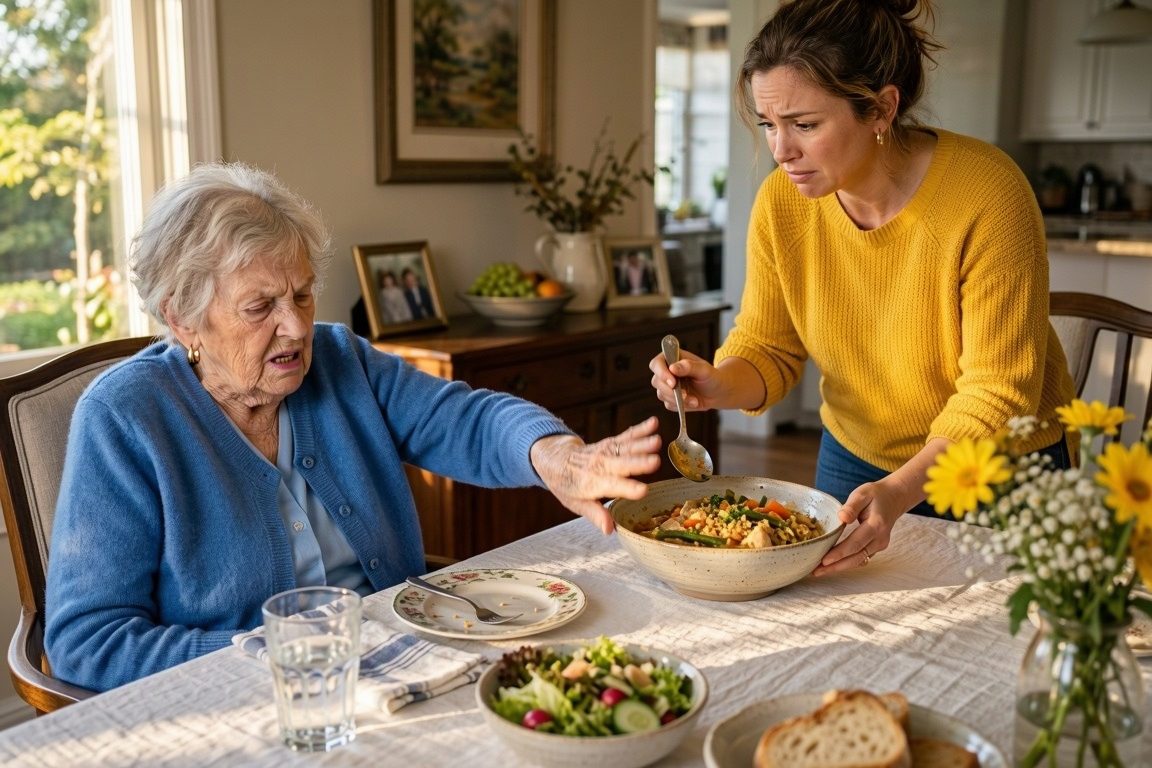
- Do not argue, reason, correct, or teach social rules; this escalates confusion and distress.
- Do not take words personally, remind yourself it is a symptom of brain damage, not a personal attack.
- Do not show anger or frustration in your face, tone, or body language; this triggers their threat response.
- Do not ignore sudden spikes in irritability or aggression; rule out medical causes (pain, infection, constipation) by calling their doctor.
- Do not handle everything alone, seek support from groups, online communities, or a counselor.
Key points
- Rudeness and lack of appreciation are symptoms of frontal lobe damage, not a reflection of your loved one's true feelings for you.
- The brain's 'brake' (frontal lobe) is failing, so raw emotions burst out without a filter. This is not a choice.
- Always check for underlying medical causes (pain, infection, hunger, fatigue) when behavior suddenly worsens.
- Use the 'validate and redirect' approach: acknowledge the feeling, then guide them to a positive activity.
- Don't argue, correct, or take it personally. Your calm response is the best medicine.
- Take care of yourself, you cannot pour from an empty cup. Seek support from groups, friends, or a therapist.
- Sudden changes in behavior warrant a call to the doctor to rule out medical issues.
Videos
 Why Does Dementia Make People Mean?Dr. Camille Sinclair explains the brain science behind meanness in dementia, including the role of the amygdala and frontal lobe. This video helps you understand why it's not personal.
 How Does Dementia Affect The Frontal Lobe Of The Brain?Answers About Alzheimer's breaks down how frontal lobe damage leads to loss of impulse control and personality changes. Includes the helpful 'brick to the head' analogy.
 What Are The First Signs Of Personality Changes In Dementia Patients?Dementia Caregiver Support For Christians discusses how personality changes are often the earliest sign of dementia, especially in frontotemporal types.
 Dementia Personality Changes First SignsDementia Careblazers covers common personality changes like irritability, flat affect, and disinhibition, with practical tips for caregivers.
2 more videos
 How to handle difficult dementia behaviors in public- simple tipDementia Careblazers gives a simple, actionable tip for handling embarrassing comments in public, including a script to use with strangers.
 The Baffled Brain: Demystifying Dementia Episode 25 May 15 ,2021Teepa Snow explains how the primitive brain (amygdala) takes over when the frontal lobe is damaged, leading to 'fight or flight' responses that look like meanness.
Background
What's Happening in the Brain: The 'Fire Alarm' Without a 'Brake'
Your loved one's brain has two key regions that normally work together: the amygdala (the 'fire alarm' that detects threats) and the frontal lobe (the 'brake' that calms impulsive reactions). In dementia, the frontal lobe shrinks and loses function, while the amygdala may become overactive. This means your loved one experiences everything as a potential problem, and they no longer have the brain capacity to pause, think, or filter their response. So when they feel frustrated, scared, or in pain, it comes out as a sharp comment or a rude outburst, not because they want to hurt you, but because their brain can't stop it.
Imagine you're driving and someone cuts you off. Your amygdala screams 'Danger!' but your frontal lobe says, 'Calm down, it's not worth it.' A person with frontal lobe damage loses that calming voice. They may blurt out exactly what they feel, like 'You stink!' or 'I hate this food!', without the social filter that would normally stop them. This is not a choice; it's a symptom of brain injury, similar to how a person with a traumatic brain injury might act differently after a brick falls on their head.
Why It Feels Personal (But Isn't): The 'Thankless Job' of Caregiving
As a caregiver, you pour your heart into helping your loved one, and when they respond with rudeness or seem unappreciative, it stings deeply. But here's the truth: the part of the brain that feels gratitude and expresses appreciation is also housed in the frontal lobe. When that area is damaged, your loved one may not be able to feel or show thanks, even if they still love you. They might also have 'flat affect,' meaning their face and voice don't match their emotions, so they might say something sad with a blank expression, making it seem like they don't care.
This doesn't mean they don't have emotions. It means they can't show them the way they used to. Think of it like a computer with a broken screen: the data is still there, but the display is glitching. Your loved one's feelings for you are still real, but the brain's 'display' for expressing them is damaged. This is why the behavior isn't about you, it's about the disease.
When Rudeness Is a Red Flag: Pain, Infection, or Other Medical Issues
Sometimes a sudden increase in meanness or irritability is a warning sign of an underlying medical problem. Your loved one might be in pain, have an infection (like a urinary tract infection), be constipated, or be experiencing depression or anxiety. Because they can't communicate 'My hip hurts' or 'I feel sick,' the discomfort comes out as anger or rudeness. One caregiver's father became extremely irritable after surgery; once his pain was treated, his personality calmed down.
So if you notice a sharp change, like your loved one suddenly swearing more, hitting, or seeming more agitated than usual, it's time to check for physical causes. Look for signs like grimacing, guarding a body part, changes in appetite, or a fever. Always discuss sudden behavioral changes with their doctor, as it could be a treatable medical issue.
Practical tools
4
The 'Brain Damage' Reframe Phrase
Silently say: 'My loved one has brain damage. They are not choosing to be mean. This is a symptom.' This separates behavior from person and reduces emotional pain.
The 'Validate and Redirect' Script
Step 1: Validate feeling ('I hear you. That sounds frustrating.') Step 2: Redirect to positive activity ('Let's look at the photo album.')
The 'Pain/Discomfort' Quick Checklist
Check for
If yes, call doctor immediately.
The 'Pattern Tracker' Log
Log columns: date, time, what was said, trigger, what helped. Review weekly to prevent episodes by adjusting routine (e.g., pre-empt hunger or sundowning).
Different situations
For frontotemporal dementia (FTD) specifically
Personality changes are often the first and most prominent symptom in FTD, sometimes appearing years before memory loss. Your loved one may become apathetic, disinhibited, or show compulsive behaviors like hoarding or eating non-food items. The advice above still applies, but you may need to be extra vigilant about safety (e.g., locking away dangerous items) and seek support from FTD-specific organizations like AFTD.
For Alzheimer's disease in later stages
As Alzheimer's progresses, the frontal lobe becomes more affected. Rudeness may be accompanied by confusion, paranoia, or hallucinations. Use very short, simple sentences (2-3 words). Avoid open-ended questions. If they accuse you of stealing, don't argue, just say 'I'll help you find it' and redirect. Also, consider that sundowning (increased agitation in late afternoon/evening) can worsen behavior; plan calming activities during that time.
For Lewy body dementia (LBD)
LBD often causes vivid hallucinations and extreme fluctuations in alertness. Rudeness may be triggered by a hallucination (e.g., they see a stranger in the room and yell at you for letting them in). Validate their reality: 'I see you're scared. That must be frightening. I'm here to keep you safe.' Then gently redirect. Avoid arguing about whether the hallucination is real. Also, be aware that LBD patients are very sensitive to antipsychotic medications, always discuss with a neurologist before using any.
For spouse vs. adult child caregiver
Spouses may feel the rudeness more personally because of the history and intimacy. It's crucial for spouses to seek couples counseling or support groups specifically for dementia caregivers. Adult children may feel guilt or resentment. Set clear boundaries: 'I will help you, but I will not accept being yelled at. I'll step away when that happens.' Both roles benefit from respite care and therapy.
For in-facility care
If your loved one is in a memory care facility, share this article with the staff. Ask them to use the same 'validate and redirect' approach. Visit during times when your loved one is most calm (often mornings). If rudeness is directed at you during visits, don't take it as a sign they don't want to see you, it's the disease. Short, positive visits (15-20 minutes) with a favorite activity (looking at photos, listening to music) work best.
Common questions
1
What abilities are lost when the prefrontal cortex is damaged?
When the prefrontal cortex is damaged, your loved one loses the ability to filter impulses, control reactions, and consider your feelings, like a car with no brakes. This means raw emotions like fear or frustration burst out as rude comments, not because they don't love you, but because their brain can't stop them anymore.
For the doctor
5
- Ask your doctor: 'Could a sudden increase in irritability or meanness be a sign of a urinary tract infection, pain, or medication side effect? Should we run any tests?'
- Ask your doctor: 'Are there any medications that might help reduce agitation or aggression in my loved one? What are the risks and benefits?'
- Ask your doctor: 'My loved one seems to have flat affect, no change in facial expression even when they say something sad. Is this normal for their type of dementia? Should we be concerned about depression?'
- Ask your doctor: 'If my loved one becomes physically aggressive, what should I do? Are there emergency protocols or medications we should have on hand?'
- Ask your doctor: 'Are there any local resources like support groups, respite care, or a dementia care specialist who can help me cope with these behaviors?'