Step by step
What not to do
- Do not argue or try to convince your loved one that they are wrong about taking their medication. If they say 'I already took it' or 'You are poisoning me,' arguing will only escalate the situation and damage trust.Instead, use a gentle redirection: 'Let's check the chart together' or 'I just want to make sure we are both on the same page.' If they are suspicious, involve a neutral third party like the pharmacist to reassure them.
- Do not leave all pill bottles out where your loved one can access them. This is an invitation for errors. Even if they have been managing their own pills for decades, the dementia has changed their ability to do so safely. Store all medications in a locked cabinet or drawer, and only take out the single dose at the time it is needed.
- Do not assume that because your loved one can still do other tasks independently, they can manage their medications. Medication management requires a level of sequencing, memory, and impulse control that is often lost earlier than other skills. As one expert put it, 'If somebody cannot remember, how do you know without a shadow of a doubt that they are taking their medicine correctly?' The answer is: you cannot. So you must put systems in place.
- Do not crush or split pills without first checking with a pharmacist. Some medications are time-release or have a special coating that must not be broken. Crushing them can cause the entire dose to be released at once, leading to overdose or dangerous side effects. Always ask first.
- Do not try to give multiple pills at once if your loved one resists or has trouble swallowing. This can cause choking or make them more resistant.Instead, give one pill at a time, with a sip of water between each. Use two sips of water before starting to ensure a strong swallow reflex. If you are unsure which pill is most critical to give first, ask your doctor or pharmacist to identify the priority order so you can safely implement this technique.
- Do not use medication time as a time for complex conversations or tasks. Keep the environment calm and quiet. Play soothing music or a favorite song to set a positive mood. If your loved one is agitated, wait until they are calmer before attempting to give medication.
Key points
- Medication errors are a leading cause of hospitalizations for people with dementia, this is a safety issue, not a control issue.
- Do not argue or try to convince your loved one; use calm redirection and involve a neutral third party like the pharmacist.
- Switch to a locked automatic pill dispenser if your loved one is tampering with pills or taking extra doses.
- Pre-sort medications yourself each week, but give your loved one a safe role like marking off a chart to preserve their sense of participation.
- Always check with the pharmacist before crushing, splitting, or hiding pills in food.
- Simplify the medication regimen by asking the doctor to review all medications and eliminate unnecessary ones.
Videos
 5. Medication Management for People with Dementia (Medications Management BASICS)This video covers the basics of setting up a safe medication system, including how to use pill organizers and what to do when errors happen.
 Alzheimer's LA Caregiver Tips - EP. 13 'Managing Medication'This video directly addresses the scenario of a loved one bringing home the wrong prescription and offers practical steps for taking over medication management.
 Medication and Prescription SafetyThis video emphasizes the importance of checking for expired medications, storing them properly, and using a single pharmacy to reduce errors.
 How to get someone with dementia to take medicationThis video demonstrates specific techniques for giving pills to someone who resists, including positioning, timing, and using food or drink to help.
Background
Why Your Loved One Misorders or Plays with Pills
When a person with dementia misorders pills or plays with them, it is almost never intentional mischief. The brain changes that come with conditions like Alzheimer's disease or Lewy body dementia affect short-term memory, sequencing (the ability to do steps in order), and impulse control. Your loved one may genuinely believe they are helping by rearranging the pills, or they may have forgotten that they already took a dose and try to take another. They might also be confused by the appearance of the pills, thinking they are candy or something to fiddle with, or they may be reacting to a feeling of being controlled or suspicious of what you are giving them.
This behavior often emerges in the middle stages of dementia, when a person can still do some tasks independently but no longer has the cognitive ability to manage the complexity of a multi-medication schedule. As one caregiver described, her mother lined up her weekly pill organizer in the order 1, 3, 2, 4 instead of 1, 2, 3, 4, causing a cascade of errors across two weeks. This is not a failure of will; it is a failure of the brain's ability to sequence and remember. Understanding this can help you respond with compassion instead of frustration.
The Real Danger: Errors That Send People to the Hospital
Medication errors are not minor annoyances, they are a leading cause of hospitalizations for people with dementia. Taking the wrong dose, the wrong pill, or a double dose can cause serious side effects, dangerous drug interactions, or toxic buildup, especially in older adults whose bodies process medications more slowly. As one expert noted, 'medication errors put people in the hospital; medication errors can kill people.' This is why getting a handle on this issue is not about being controlling, it is about protecting your loved one's life.
At the same time, the emotional toll on you as a caregiver is real. You may feel like you are constantly policing, arguing, or cleaning up messes. You might worry that you are taking away your loved one's independence or that they will resent you. The goal of the strategies below is to find a balance: keep your loved one safe and involved in their own care in a way that works for their current abilities, without turning medication time into a power struggle.
Practical tools
6
Locked Automatic Pill Dispenser
A device like the 'Med-Q' or 'Hero' that locks all pills inside and releases only the correct dose at the programmed time. This prevents tampering, double-dosing, and misordering. Set it up in a location your loved one cannot access, and only bring the single dose cup to them at medication time.
Weekly Pill Organizer with Large Print Labels
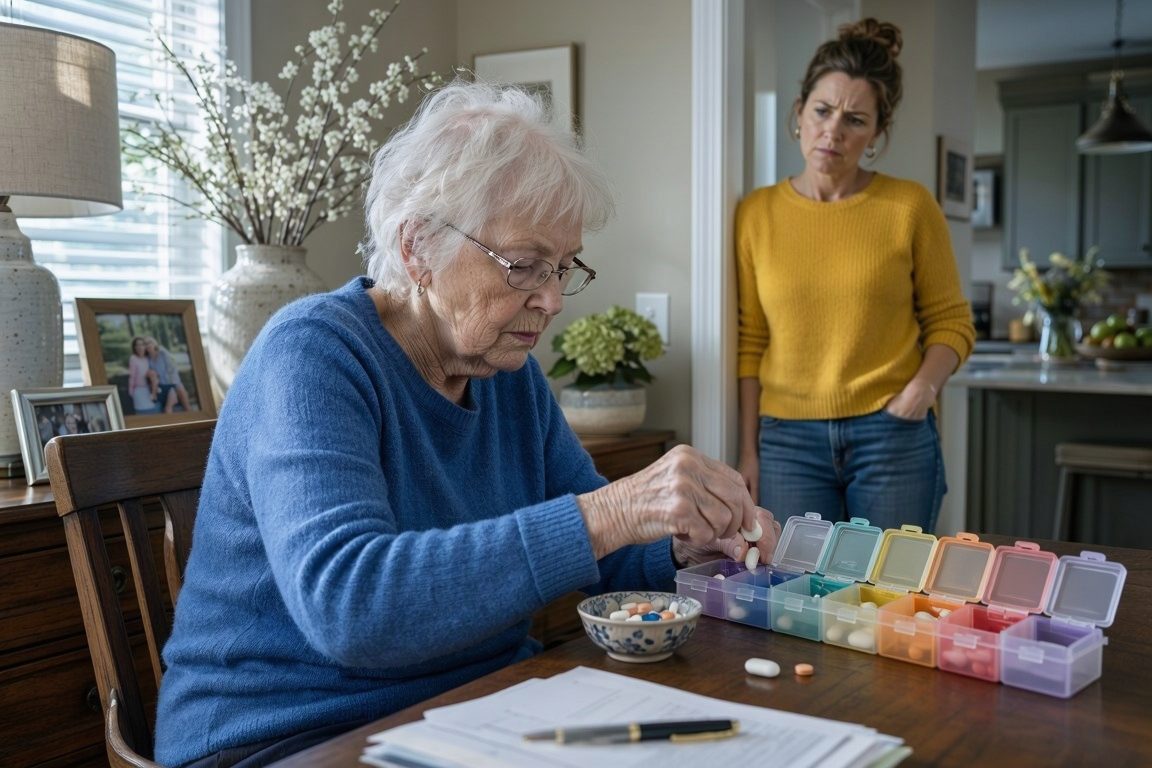
If your loved one is still able to take their own pills with supervision, use a weekly organizer with large, clear labels for each day and time (morning, noon, evening, bedtime). Fill it yourself each week, and double-check that the pills are in the correct order before your loved one uses it. Do not let them fill it themselves.
Medication Tracking Chart
Create a simple paper chart with columns for date, time, medication name, and a checkbox. After each dose, have your loved one (or you) check the box. This gives a visual record and reduces the chance of double-dosing. Keep it on the refrigerator or near the medication area.
The 'Two Sips' Technique for Swallowing
Before giving the pill, have your loved one take two sips of water to lubricate the throat and trigger the swallow reflex. Then place the pill on the back of the tongue and follow with another sip. This reduces the chance of choking and makes swallowing easier. Do not give multiple pills at once. If your loved one starts to choke, stop immediately and seek emergency help.
Pharmacist Consultation
Ask your pharmacist for a 'medication therapy management' review. They can check for interactions, suggest liquid or patch forms, print labels in large font, and provide easy-open containers. This is a free or low-cost service at many pharmacies and can dramatically simplify the medication regimen.
Calm Redirection Phrases
When your loved one refuses or argues, use these exact phrases: 'I hear you. Let's take a break and come back to this.' 'I just want to make sure we are both safe.' 'Let's check with the pharmacist together.' 'I love you and I want to help you stay healthy.' Avoid arguing, correcting, or using logic.
Different situations
Lewy body dementia or Parkinson's disease dementia
These conditions often involve visual hallucinations and extreme sensitivity to medications. Your loved one may be more suspicious of pills or see them as something else entirely. Use a locked dispenser and involve the pharmacist early. Also, be aware that some medications (like antipsychotics) can cause severe reactions in Lewy body dementia, always discuss any new medication with the neurologist first.
Late-stage dementia (unable to swallow or cooperate)
At this stage, you may need to use liquid, patch, or injectable forms of medication. Work with the doctor and hospice team to simplify the regimen to only essential medications. If your loved one refuses to open their mouth, do not force it, try a different time or a different form. Never crush pills without checking, and never hide medication in food without the doctor's approval.
Adult child caregiver vs. spouse caregiver
Adult children may find it easier to take control because they are used to a parent-child dynamic, but they may also face more resistance from the parent who feels infantilized. Spouses may struggle with role reversal and guilt. In both cases, use neutral language: 'The doctor said we need to try this new system' rather than 'I think you need help.' Involve a third party (pharmacist, doctor, home health aide) to reduce conflict.
Living in a facility (assisted living or nursing home)
In a facility, the staff should manage medications, but you still need to be vigilant. Ask to see the medication administration record (MAR) regularly. Request that the facility use a locked dispenser if your loved one is tampering with pills. If your loved one is in a memory care unit, ask about their protocol for medication refusal or hoarding. You have the right to request a pharmacy consult.
Medicaid or limited income
Locked automatic pill dispensers can be expensive. Check with your local Area Agency on Aging or Alzheimer's Association chapter for loaner programs or low-cost options. Some pharmacies offer free pill organizers. Ask the doctor about generic versions or patient assistance programs to reduce the number of pills. You can also use a simple lockbox from a hardware store to store medications.
For the doctor
6
- Ask the doctor: 'Are all of my loved one's medications still necessary? Can any be discontinued or combined to reduce the number of pills?'
- Ask the pharmacist: 'Is it safe to crush this medication? Is there a liquid or patch version available?'
- If your loved one is on dementia medications (like Aricept, Exelon, Razadyne, or Namenda) and they were prescribed over six months ago, ask the doctor to review whether they are still appropriate for the current stage of the disease.
- If your loved one is refusing medication consistently, ask the doctor about alternative forms (liquid, patch, injection) or a different medication altogether.
- If your loved one is on multiple medications from different specialists, ask for a 'medication reconciliation' to ensure the specialists' computers are communicating and there are no dangerous interactions.
- Ask the doctor or pharmacist: 'If I need to give pills one at a time due to resistance or swallowing issues, which pill should I prioritize as most important to give first?'