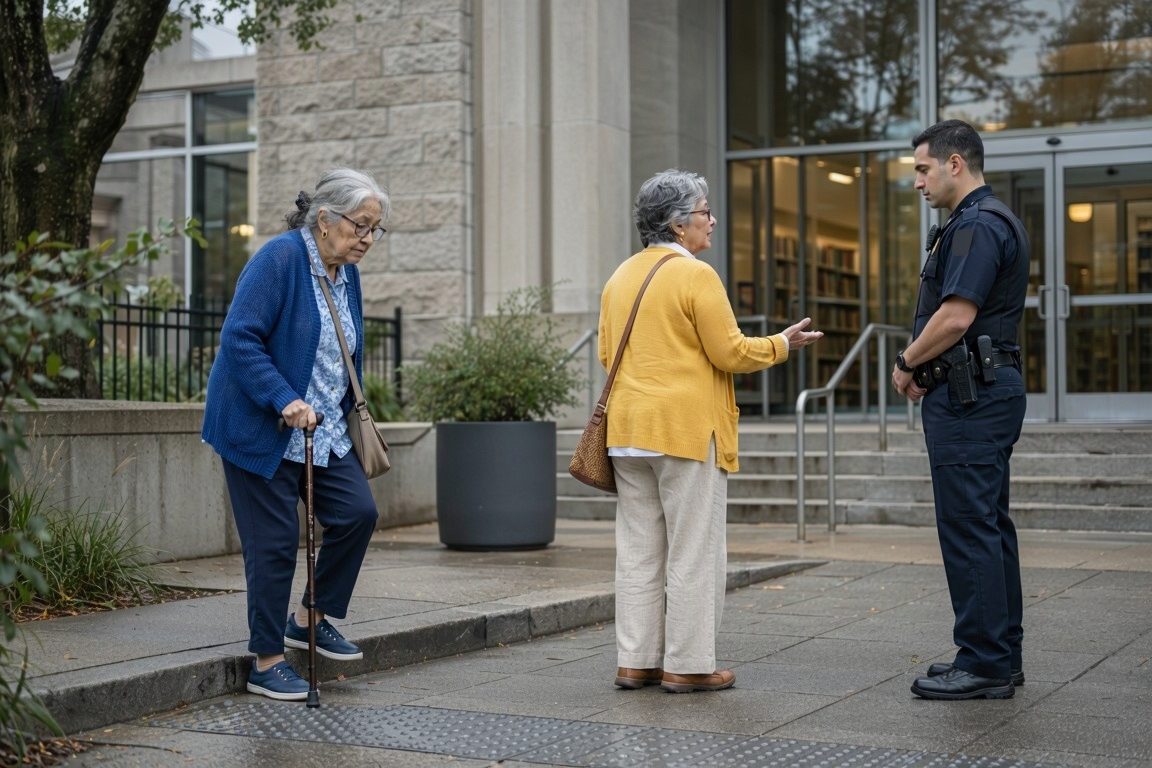
Step by step
What not to do
- Don’t assume the officer will recognize Parkinson’s. Most have no training.Instead, prepare a simple explanation and medical documentation to hand over.
- Don’t let your loved one argue or become defensive. This can escalate the situation.Instead, coach them to stay calm, speak slowly, and follow instructions as best they can.
- Don’t hide the diagnosis from your loved one or from first responders. Secrecy increases risk.Instead, be open about the condition and carry visible identification.
- Don’t wait for a crisis to prepare. Role-play and create materials now, while your loved one can still participate. Waiting until symptoms worsen makes it harder.
- Don’t assume a single encounter will change an officer’s behavior. Follow up with a thank-you note if it went well, or a constructive complaint if it didn’t. Persistence helps build awareness.
Key points
- Parkinson’s motor symptoms (tremors, slow movement, slurred speech) and non-motor symptoms (confusion, hallucinations) can look like alcohol or drug intoxication to untrained observers.
- Prepare ahead: a medical alert card, a one-page summary, and a calm communication script can prevent or de-escalate a police encounter.
- Most police officers have no training on Parkinson’s. You can help by educating your local department with a short packet or training request.
- Never leave a loved one with advanced Parkinson’s or dementia alone in public. Always have a caregiver present who can advocate.
- After any encounter, document it and follow up with the police department to build awareness and prevent future incidents.
- Discuss medication-related psychosis with your neurologist, there are treatments that can reduce hallucinations and paranoia.
Videos
 Bruce McIntyre of Oklahoma Parkinson's Alliance & Kristin Rossi of Michigan Parkinson FoundationThis video discusses real-life police encounters with people who have Parkinson’s and offers insights from advocacy organizations on how to improve first responder training.
 Ep. 294: Parkinson's and Emergency ServicesThis episode focuses specifically on how emergency services, including police, can better recognize and respond to Parkinson’s symptoms, with practical advice for caregivers.
 The Care Advocates with Lance A. Slatton & Sharon's Son, George with Care Advocate Kimberly JacobsenThis video includes caregiver stories and advocacy tips for navigating medical and emergency systems, including police interactions.
 Different Types of Dementia, Symptoms, Life Expectancies and CausesHelps distinguish Parkinson’s disease dementia from other dementias, which is important for understanding how symptoms may be misinterpreted.
2 more videos
 The Parkinson's You Don't See: Cognitive and Non-Motor SymptomsExplains the invisible symptoms of Parkinson’s, cognitive changes, fatigue, psychosis, that can lead to misunderstandings with police.
 The Parkinson's You Don't See: Cognitive and Non-Motor SymptomsAnother perspective on the same topic, reinforcing how non-motor symptoms are often overlooked but critical in police encounters.
Background
The Visible Symptoms That Mimic Intoxication
Parkinson’s disease causes a range of motor symptoms that are physically noticeable. Tremors, muscle rigidity, slow movement (bradykinesia), a shuffling walk, and a stooped posture are common. Slurred speech (dysarthria) and a fixed facial expression (hypomimia) can make a person appear confused, uncooperative, or under the influence. These signs are so visual that even well-meaning observers, including police officers, may jump to the wrong conclusion. As one source notes, a person with Parkinson’s may shake uncontrollably, struggle to open a car door, and have speech that sounds slurred, all of which can be misinterpreted as intoxication (All Home Care Matters).
The Invisible Symptoms That Add to the Confusion
Beyond the motor signs, Parkinson’s has non-motor symptoms that are often invisible to others. These include fatigue, apathy, depression, anxiety, and cognitive changes such as slowed thinking or difficulty processing information. Psychosis, hallucinations (usually visual) and paranoid delusions, can occur, especially as a side effect of Parkinson’s medications. A person may see or hear things that aren’t there, or believe someone is out to harm them. These symptoms can make a person appear agitated, confused, or irrational, which police may interpret as intoxication or mental illness. Research shows that psychotic symptoms in Parkinson’s are common, often medication-related, and can include paranoid delusions that cause great distress (Friedman, 2010).
Why Police May Misread the Situation
Most police officers receive little to no training on Parkinson’s disease or its symptoms. As one expert explains, from the starting line, most people don’t know anything about Parkinson’s (All Home Care Matters). When an officer sees a person who is shaking, speaking unclearly, moving slowly, and possibly acting confused or paranoid, the most common assumption is alcohol or drug intoxication. The person may also have difficulty following commands due to cognitive slowing or physical limitations, which can be seen as noncompliance. Without awareness of Parkinson’s, the officer may escalate the situation, leading to a dangerous outcome. This is especially risky if the person also has dementia, which affects judgment and communication.
Practical tools
5
Medical Alert Card or Bracelet
A laminated card that says: ‘I have Parkinson’s disease. Symptoms may include tremors, slow movement, slurred speech, and confusion. I am not intoxicated. Please call [caregiver name and phone].’ Keep in wallet or on a bracelet. Free templates are available from the Parkinson’s Foundation.
One-Page Medical Summary
A single sheet listing:
Keep in car and at home.
Calm Communication Script
Exact words to say: ‘I have Parkinson’s. I am not drunk. I need to move slowly. Please call my caregiver at [number].’ Practice this phrase until it feels natural. For caregivers: ‘Officer, my family member has Parkinson’s. Their symptoms can look like intoxication. Please give us a moment.’
Police Department Education Kit
A short packet you can drop off or email to your local police department’s training officer. Include:
Many departments are receptive (All Home Care Matters).
Vulnerable Person Registry
Check if your local police or sheriff’s department offers a voluntary registry for people with medical conditions. You provide info (diagnosis, photo, emergency contacts) that dispatchers see when 911 is called. This can prevent misunderstandings before an officer arrives.
Different situations
If your loved one has Lewy body dementia (LBD)
LBD includes both Parkinson’s motor symptoms and early, prominent hallucinations. The risk of being mistaken for intoxicated is higher because hallucinations can cause agitation or confusion. Emphasize on the medical alert card: ‘May have visual hallucinations. Do not argue. Call caregiver.’ Also, note that LBD patients are extremely sensitive to antipsychotic medications, discuss with your clinician before any medication is given.
Late-stage Parkinson’s or Parkinson’s disease dementia (PDD)
Cognitive decline makes it harder for your loved one to follow commands or explain their condition. They may not remember their own name or diagnosis. In this stage, you should never leave them alone in public. If an encounter happens, you must be present to advocate. The medical summary should include: ‘Patient has dementia. May not understand commands. Please speak slowly and give extra time.’
Spouse vs. adult child caregiver
A spouse may be more emotionally reactive during a police encounter. Practice staying calm together. An adult child may need to take the lead in preparing materials and contacting police. Both should carry the medical summary and know the script. If the person with Parkinson’s lives alone, an adult child should ensure the medical alert card is always on them.
If your loved one lives in a facility (assisted living or nursing home)
Facility staff should have a protocol for police encounters. Ask the facility to include Parkinson’s symptoms in the resident’s care plan and to train staff on how to intervene. If your loved one wanders, consider a GPS tracker or Safe Return bracelet. The facility should also have a copy of the medical summary on file.
If your loved one has a history of alcohol use
Chronic alcohol use can worsen Parkinson’s symptoms or even provoke parkinsonism during withdrawal (Carlen et al., 1981). Be honest with medical providers about alcohol history. On the medical alert card, you may add: ‘May have alcohol history. Symptoms are due to Parkinson’s, not current intoxication.’ Discuss with your clinician how to manage both conditions safely.
For the doctor
5
- Ask your neurologist: ‘What specific symptoms of my loved one’s Parkinson’s are most likely to be misinterpreted as intoxication? How can we document this in a way that police will understand?’
- Discuss whether current Parkinson’s medications could be causing or worsening hallucinations or paranoia, and whether a dose adjustment might reduce those symptoms.
- Ask about a ‘Parkinson’s psychosis’ medication like pimavanserin (Nuplazid) if hallucinations are a problem. This is a prescription drug that must be managed by a specialist.
- If your loved one has Lewy body dementia, ask about the risks of using antipsychotic medications, which can cause severe reactions. Get a written list of safe and unsafe drugs.
- Request a letter from the neurologist that states the diagnosis and explains that symptoms can mimic intoxication. Keep a copy with the medical summary.