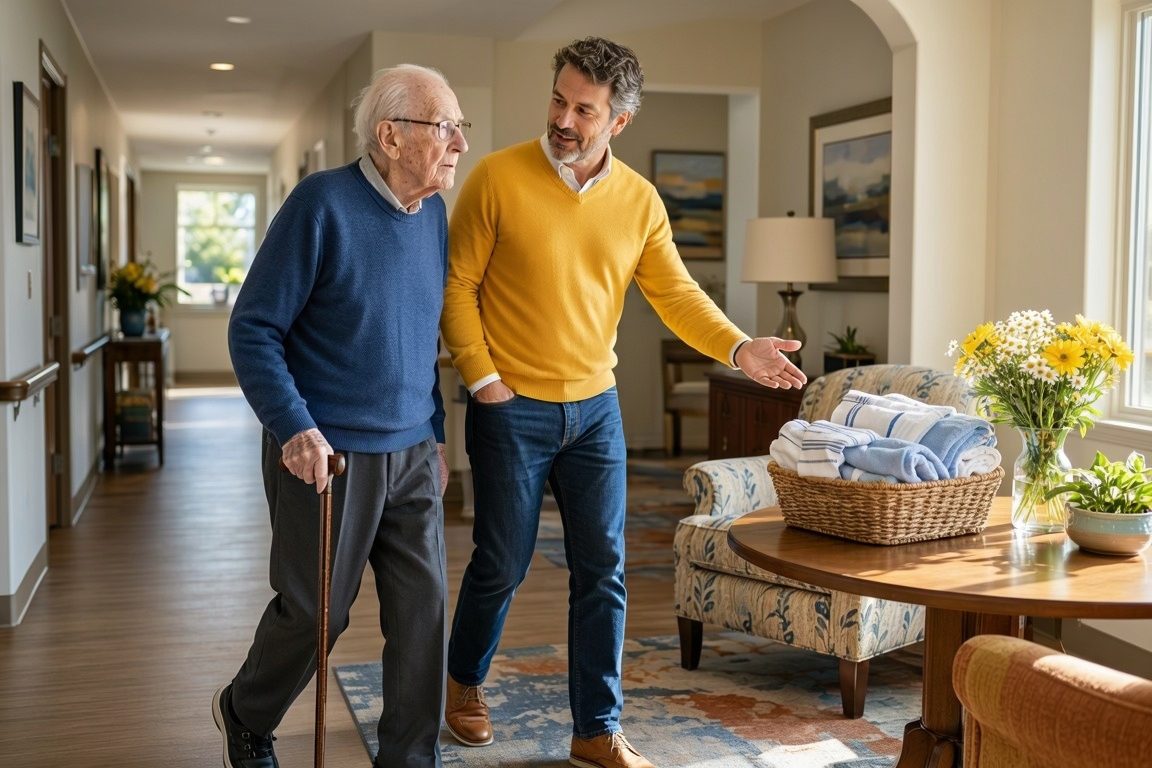
Step by step
What not to do
- Do not argue or correct: Saying 'This is your home, you've lived here for years' will only increase their agitation and make them feel misunderstood.Instead, validate their feeling: 'You miss your old home. I understand.'
- Do not physically block or grab them: This can be perceived as a threat and may trigger a fight-or-flight response.Instead, step to the side and use a gentle, guiding hand on their elbow to turn them.
- Do not use a loud or urgent tone: Shouting 'Stop!' or 'No!' will escalate their confusion and fear. Speak softly and slowly, using their name frequently to ground them.
- Do not try to redirect too quickly: If you jump straight to a new activity without first acknowledging their goal, they will likely resist. They need to feel heard first. Use the 'acknowledge, then redirect' sequence.
- Do not leave them unsupervised after a redirection attempt: Even if they seem calm, the urge to wander can return quickly. Stay with them or ensure another staff member is nearby.
- Do not assume all wandering is the same: A person in early-stage dementia may be disoriented while walking a familiar route, while someone in later stages may be purposefully exit-seeking. Tailor your response to the stage and the trigger.
Key points
- Always validate the emotion before redirecting: 'I hear you. You miss home.'
- Use the 'delay and redirect' technique to buy time and let the urge pass.
- Offer a sensory or purposeful activity that aligns with their interest (e.g., photos, folding towels, walking).
- Never argue, correct, or physically block. Use a calm tone and gentle guidance.
- Create a safe environment: clear pathways, nightlights, and camouflaged exits.
- Practice redirection daily; it becomes easier and more natural over time.
Videos
 Alzheimer's and Wandering - Professional Caregiver WebinarThis professional-level webinar covers triggers, redirection techniques, and environmental modifications specific to memory care facilities.
 Dementia Wandering: Prevention + What to Do If They Go Missing | Dr. Khushboo VermaDr. Verma explains the 'delay and redirect' method in detail and offers practical scripts for in-the-moment use.
 3 steps to stop difficult dementia behaviors using redirectionThis video breaks down the three-step redirection process (acknowledge, validate, redirect) with clear examples.
 HOW TO MANAGE Wandering, Pacing, Eloping ~ Smart Tricks When You Are DesperateOffers creative, low-cost tricks for redirecting pacing and elopement, including the use of sensory items and walking paths.
2 more videos
 How to redirect difficult dementia behaviors (3 mistakes to avoid)Highlights common redirection mistakes (e.g., correcting, rushing) and shows how to avoid them with a calm, stepwise approach.
 Courageous Conversation with Dale Dawson from Law EnforcementProvides critical safety information on what to do if a resident elopes, including how to work with law enforcement and use ID/GPS tools.
Background
Why Wandering Happens in Memory Care
Wandering is not random; it is almost always driven by an unmet need or a feeling of being lost in time and place. A resident may be trying to 'go home' because they are reliving an old memory, feeling anxious in an unfamiliar environment, or experiencing boredom, restlessness, or even a physical need like needing the bathroom. In a facility, the sight of a door, a coat rack, or a purse can trigger the automatic thought, 'I need to leave for work' or 'I must pick up the kids.' The person is not being difficult; their brain is responding to a deep, often emotional drive to return to a place that feels safe and known.
The Core Principle: Validation Before Redirection
The most common mistake is to jump straight to 'correcting' the person, telling them the family farm is gone or that this is their home. This causes distress, agitation, and makes them more determined to leave. Instead, you must first acknowledge their reality and the emotion behind it. For example, if they say 'I want to go home to the farm,' you can say, 'I hear you. You miss the farm and the good times there.' This validation lowers their anxiety and opens a door for connection. Only after they feel heard can you gently guide them toward a different activity or topic. This is the art of redirection: first join them in their world, then slowly invite them into yours.
The 'Delay and Redirect' Strategy
A powerful technique is to 'delay and redirect.' Instead of saying 'no,' you agree to the idea but introduce a small, logical step first. For instance, if they want to leave to go home, say, 'That's a long way to go. Would you like to use the restroom first? Or maybe grab a snack before we head out?' This buys time. Often, the urge to leave passes during that delay. If they still want to go after the snack, you can say, 'Okay, let me come with you. I need to run an errand too.' This keeps them safe and turns the exit into a shared, supervised activity. The goal is not to stop the behavior abruptly, but to gently steer it into a safer channel.
Practical tools
6
The 'Validation and Delay' Script
A simple three-step verbal tool: 1) Acknowledge: 'I hear you want to go home.' 2) Validate emotion: 'You miss the farm. That's a special place.' 3) Delay: 'It's a long way. Let's sit down and have a cup of tea first. I'll come with you.' Practice this script until it feels natural.
The 'Walking Companion' Protocol
If a resident insists on leaving, do not block them. Instead, say, 'I'll walk with you. I need to stretch my legs.' Walk alongside them in a safe, enclosed area. This meets their need for movement and companionship while preventing elopement. Use a calm, conversational tone to gradually steer them away from the exit.
Sensory Redirection Kit
Prepare a small basket or cart with items that engage the senses:
When a resident is agitated or exit-seeking, offer one of these items and say, 'Here, hold this. It's so calming.' The sensory input can shift their focus.
Environmental Cues: The 'Path to Purpose'
Use rope lighting or colored tape on the floor to create a safe walking path from the resident's room to a common area, the dining room, or a garden. This reduces confusion and helps them find their way without wandering into unsafe areas. Also, place a 'busy board' or a 'memory wall' with familiar photos along the path to naturally draw their attention.
The 'Activity Menu' Checklist
Keep a laminated list of quick, low-prep activities that can be offered in the moment: folding towels, sorting socks, looking at a magazine, watering a plant, or listening to a short piece of music. Have these ready in a drawer or cart. When you need to redirect, say, 'I was just about to do this. Would you help me?' Purposeful activity reduces the urge to wander.
The 'Safety First' ID and GPS Kit
Ensure every resident wears an ID bracelet with the facility name and contact number. For those at high risk of elopement, discuss with the family and clinician about using a GPS tracker (e.g., a smartwatch or a shoe insert). Also, keep a recent photo and a list of their favorite places (e.g., 'the old farm') to share with law enforcement if needed.
Different situations
Early-stage dementia (resident is still verbal and can follow conversation)
Use more open-ended questions like 'Where are you headed?' and engage in a longer conversation about their destination. You can also use logical reasoning: 'It's raining right now. Let's wait until it clears.' The delay technique is very effective here. Also, consider offering to 'drive' them in a simulated car ride (e.g., sit in a parked car in the facility's garage) to satisfy the urge.
Middle-to-late stage (limited verbal ability, high confusion)
Focus on non-verbal redirection. Use a gentle touch on the arm, a calm smile, and a simple phrase like 'Let's walk this way.' Offer a sensory item like a soft toy or a familiar song. Do not try to reason or explain. Instead, mirror their emotion: if they look anxious, say 'You're worried. I'm here.' Then guide them to a safe, quiet area.
Resident with Lewy body dementia (fluctuating cognition, hallucinations)
Be extra cautious about visual triggers. A coat on a hook might look like a person, or a shadow might seem like a door. Reduce visual clutter and use nightlights. When redirecting, acknowledge any hallucination without arguing: 'I see you're looking at something. It seems scary. Let's move to the other room where it's brighter.' Avoid sudden movements or loud noises, as they can trigger a fall or agitation.
Caregiver role: staff member vs. family visitor
Staff should use consistent redirection techniques across shifts to avoid confusing the resident. Family visitors should be coached on the 'validation before redirection' approach and should not undermine staff efforts by saying 'I'll take you home.' Instead, they can say, 'I'm here to visit with you. Let's look at photos together.'
Facility environment: locked unit vs. open unit
In a locked unit, the risk of elopement is lower, but wandering within the unit can still cause falls or distress. Use the 'walking companion' tool and create clear, labeled pathways. In an open unit, increase environmental barriers (e.g., camouflaged door handles, alarms) and have a lower threshold for using GPS tracking. Always have a plan for the 'what if' scenario.
For the doctor
4
- If the wandering is accompanied by aggressive behavior or a sudden change in pattern, discuss with the facility's medical director to rule out infection, pain, or medication side effects.
- If the resident is on medications that affect balance or cognition (e.g., sedatives, antipsychotics), ask the clinician if a review or adjustment is appropriate to reduce the risk of falls during wandering.
- If the resident has a history of elopement and the facility is considering a GPS tracker or a door alarm, discuss the ethical and practical implications with the care team and the resident's legal representative.
- If the resident is at high risk of injury from wandering (e.g., due to osteoporosis or a recent fall), ask about a formal 'wandering risk assessment' and a personalized safety plan that may include a lower bed, hip protectors, or a supervised walking program.