Step by step
What not to do
- Do not say 'I'm just trying to help', this can feel patronizing and remind them of their lost independence.Instead, say 'I'm here with you' or 'Let's do this together.'
- Do not argue or correct their memory. Saying 'I already told you' or 'That's not true' will only escalate their frustration.Instead, validate the emotion behind their words.
- Do not use a rushed or loud tone. Speaking quickly or loudly signals danger to their brain. Slow down, lower your voice, and use short, simple sentences.
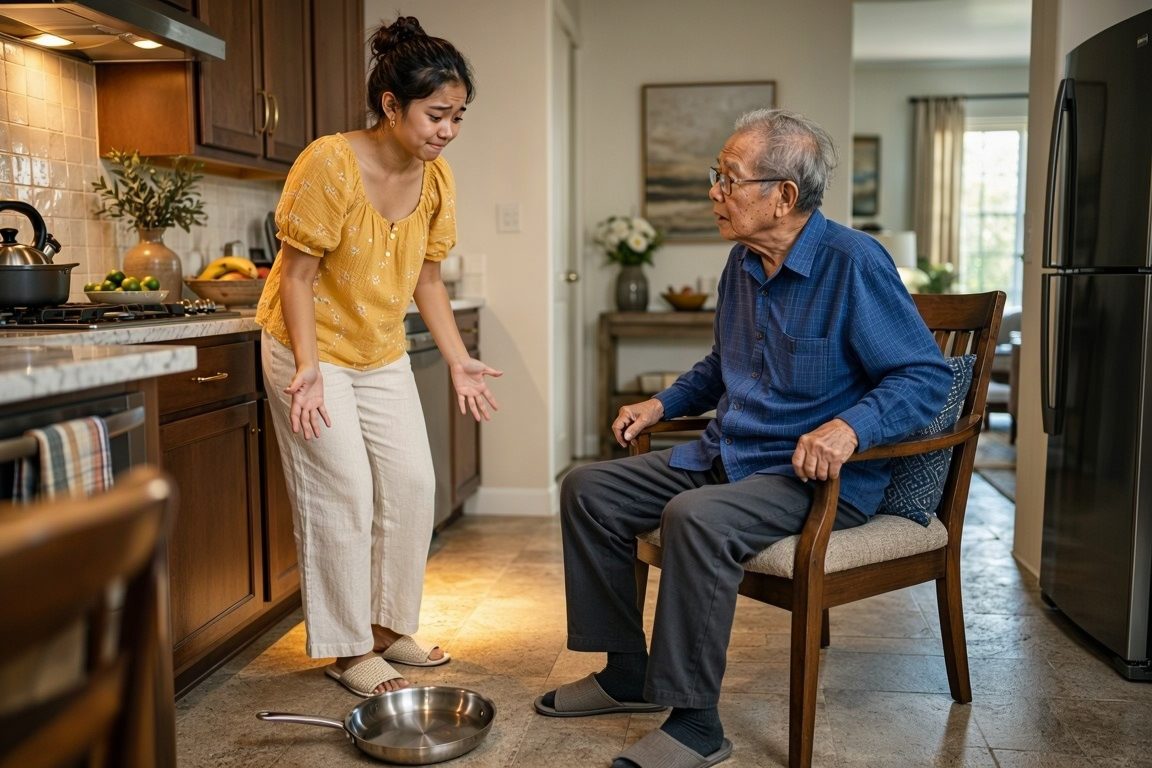
- Do not tower over them or stand directly in front of them. This can feel threatening.Instead, sit or kneel to their eye level, or approach from the side.
- Do not initiate physical contact during an outburst. If they are already agitated, touching them may feel like an invasion. Wait until they have calmed down, then offer a gentle touch if they seem open.
- Do not take their words personally. Their anger is a symptom of their disease, not a reflection of your care. Remind yourself: 'This is the dementia talking, not my loved one.'
Key points
- Apologize by validating the emotion, not the facts, say 'I see you're upset' not 'I'm sorry you're wrong.'
- Your body language speaks louder than words: stay calm, use a soft tone, and avoid towering or sudden movements.
- Use short, simple sentences and a slow pace, especially when they are already upset.
- Never argue, correct, or remind them of their memory loss, it only escalates distress.
- After the upset, offer a small choice or a calming activity to restore their sense of control.
- You are not failing, this is a skill you can learn. Every small success builds trust and safety for both of you.
Videos
 Simple way to respond to difficult dementia behaviorThis video shows a practical, step-by-step approach to responding to upset behavior, including how to validate emotions and use body language effectively.
 Dementia: Your Questions AnsweredAnswers common caregiver questions about why people with dementia get upset and how to apologize without making things worse.
 10 Tips For Responding To Anger in DementiaOffers ten concrete tips for de-escalating anger, including specific phrases and body language adjustments.
 Aggressive Behavior in People with Dementia | Linda Ercoli, PhD | UCLAMDChatA clinical expert explains the brain-based reasons for aggression and how to respond safely and compassionately.
2 more videos
 What's Wrong with Grandpa? (Talking with Kids about Dementia and Alzheimer's Disease)Helpful for families with children, shows how to explain dementia and model calm responses to upset behavior.
 How To Handle A Person With Alzheimer's?Covers general handling techniques, including how to apologize and use non-verbal cues to signal safety.
Background
Why Your Loved One Gets Upset and What Your Apology Means to Them
When a person with dementia becomes upset, it is rarely about you personally. Their brain is struggling to process the world around them, and they often feel confused, frightened, and out of control. This fear can turn into frustration and then anger, which may be directed at you because you are the closest, safest person. They are not doing it on purpose, their brain is reacting to a perceived threat or discomfort they cannot name. Your apology, when done right, tells them: 'I see you are struggling, and I am here to help.' It validates their emotion without correcting their reality, which is exactly what they need to feel safe again.
The Power of Non-Verbal Communication in Apologizing
People with dementia rely heavily on body language, tone of voice, and facial expressions, often more than on words. If you look tense, frustrated, or scared, they will pick up on that and mirror it, making the situation worse. A genuine apology must be paired with a calm, open posture, a soft tone, and gentle eye contact. Your body language can say 'I am safe, you are safe' even before you speak. Remember, they may not understand every word you say, but they will feel your intention. Approaching from their dominant side, using a relaxed stance, and avoiding towering over them are all ways to signal safety non-verbally.
Practical tools
6
The 'I See You' Apology Script
A simple phrase to use when upset: 'I see you're upset. I'm sorry. How can I help?' This validates their emotion, apologizes without blame, and offers support. Practice saying it in a calm, soft tone.
Calm Body Language Checklist
Before you speak, check your posture:
Avoid frowning, sighing, or looking at your watch. Your body language should say 'I am safe and here for you.'
The 'Let's Fix It Together' Redirect
If they are upset about a perceived problem (like a missing item), say: 'Oh no, that's not good. Let's look for it together.' This joins their reality and gives them a sense of partnership and control.
Environmental Calming Setup
After an upset, reduce noise and distractions.
A calm environment helps their brain reset and feel safer.
The 'Safe Space' Gesture
If they are very agitated, guide them to a familiar, quiet spot, like their favorite chair or a cozy corner. Say: 'Let's sit here. You're safe.' Use a soft blanket or a familiar object to ground them.
The 'Pause and Breathe' Card
Keep a small card in your pocket or on your phone that says: 'Pause. Breathe. Soft voice. Slow. Validate.' Use it as a quick reminder when you feel overwhelmed.
Different situations
Lewy body dementia
People with Lewy body dementia often have visual hallucinations and fluctuating alertness. If they are upset by something they see, do not argue about its reality. Instead, say: 'I see that too. Let's move to another room.' Use calm, slow movements and avoid sudden changes in light or noise, which can trigger more confusion.
Late-stage dementia
In late stages, your loved one may not understand words at all. Focus entirely on non-verbal cues: a gentle touch, a soft humming, or a warm smile. Use a rhythmic, soothing voice. Avoid any complex sentences, just a simple 'It's okay' repeated softly. Your presence and calm energy are the apology.
Spouse vs. adult child caregiver
As a spouse, your loved one may have a long history of expecting you to 'fix' things. An apology that feels too formal might confuse them. Use familiar, loving language: 'I'm sorry, honey. I'm here.' As an adult child, you may need to balance respect with authority. Say: 'I'm sorry, Mom. I'm here to help you. You're safe.' Avoid sounding like you are scolding or parenting them.
In a facility or with hired caregivers
If you are not the primary caregiver, coordinate with staff to ensure consistency. After an upset, ask the caregiver to use the same calming phrases and body language you use. Share this guide with them. If your loved one is upset by a caregiver, step in gently and model the apology, then step back so they can rebuild trust.
Medicaid or limited resources
If you cannot afford professional help, lean on community resources like local Alzheimer's Association support groups or free online videos (see the videos section). Use simple, low-cost tools: a soft blanket, a favorite song, or a quiet corner. Your calm presence is the most powerful tool, and it costs nothing.
For the doctor
4
- If your loved one's aggression or agitation becomes frequent or dangerous (e.g., hitting, biting, or throwing objects), ask the doctor about possible medication adjustments or non-drug interventions.
- If you suspect a urinary tract infection (UTI) or other medical issue is causing sudden behavioral changes, consult a clinician immediately: UTIs can worsen dementia symptoms.
- If your loved one is on medications that affect mood or behavior (like antipsychotics or antidepressants), discuss with the prescriber whether the dose or type needs to be reviewed.
- If you feel overwhelmed or unsafe, ask your doctor or a social worker about respite care, adult day programs, or in-home support services.