Step by step
What not to do
- Do not assume they are being clumsy or careless. Visual processing problems are not a choice. Scolding or criticizing will only increase their anxiety and confusion.Instead, offer gentle guidance and simplify the environment.
- Do not rearrange furniture or change the layout of their home. Even small changes can be disorienting. Keep everything in the same place to maintain a sense of familiarity and safety.
- Do not rely on them to tell you they are having visual problems. They may not realize it themselves or may be embarrassed to admit it. Watch for behavioral cues like hesitation, frustration, or withdrawal.
- Do not use busy patterns or low-contrast colors in their living space. Striped wallpaper, floral rugs, or dark furniture against dark walls can be confusing. Stick to solid, high-contrast colors for walls, floors, and furniture.
- Do not ignore sudden changes in vision. A rapid decline in visual ability could indicate a medical emergency like a stroke or a medication side effect. If the change is sudden, seek immediate medical attention.
- Do not force them to do tasks that require quick visual decisions, like driving or using a sharp knife. This can be dangerous.Instead, find safer alternatives, such as using a pre-cut vegetable tray or arranging for a ride service.
Key points
- Visual processing problems in dementia are brain-based, not eye-based, they affect how the brain interprets what the eyes see.
- Daily signs include trouble finding items in cluttered spaces, bumping into furniture, losing place while reading, and difficulty with quick visual decisions like driving.
- Increase contrast in the environment (e.g., dark plate on light table) and reduce clutter to help your loved one navigate more easily.
- Use verbal labeling when handing over objects: 'Here is your cup' helps the brain connect visual and verbal cues.
- Never assume clumsiness or stubbornness, these behaviors are symptoms of a brain change and require patience and environmental adjustments.
- Document specific visual difficulties and share them with healthcare providers to aid in diagnosis and care planning.
Videos
 Could Your Vision Predict Your Dementia Risk?This video explains how visual processing speed can predict dementia risk years before diagnosis, helping caregivers understand the importance of early detection.
 How Dementia Changes What They SeeThis video provides a clear, visual explanation of how dementia alters visual perception, making it easier to empathize with your loved one's experience.
 Medications Used in Dementia: What Caregivers Should Know | Sarah Mourra MD | UCLAMDChatThis video covers medication management, including how some drugs can affect vision or interact with visual processing issues, important for safety.
 How To Cope With Caregiver StressCaregiver stress is common when dealing with visual processing challenges. This video offers practical coping strategies to prevent burnout.
2 more videos
 Inside a Dementia Clinic: What REALLY Happens? Invited talk by Dr. Khushboo VermaThis video demystifies the diagnostic process, including how visual symptoms are assessed, helping caregivers know what to expect during a clinic visit.
 What Is Caregiver Burden During Dementia Progression? - TestThis video addresses the emotional and physical toll of caregiving, which is especially relevant when managing complex visual processing issues.
Background
What Is Happening in the Brain
In dementia, especially Alzheimer's disease, the brain's ability to process visual information becomes disrupted. This is not a problem with the eyes themselves but with how the brain interprets what the eyes see. As noted by the Alzheimer's Association, one of the ten warning signs of Alzheimer's is 'trouble understanding visual images and spatial relationships.' This means that even with perfect vision, a person may struggle to recognize objects, judge distances, or navigate their environment. The brain may not 'understand fully what it's seeing,' as described by Dementia Careblazers, leading to confusion and hesitation.
Why This Happens: The Brain's Visual Pathways
The brain has specialized areas for processing visual information, including the occipital lobe (primary vision) and the parietal lobe (spatial awareness). In dementia, these areas can be damaged by the buildup of abnormal proteins, such as amyloid plaques and tau tangles. This damage slows down visual processing speed and impairs the brain's ability to integrate visual cues with other senses. A study highlighted by Dementia Careblazers found that changes in visual processing speed could predict dementia up to 12 years before diagnosis. This means that subtle visual difficulties, like missing a triangle forming in a field of moving dots on a computer test, can be an early sign of underlying brain changes.
How This Shows Up in Daily Life
Your loved one may seem to 'lose their place' while reading, take longer to find items on a cluttered shelf, or bump into furniture more often. They might appear less confident in familiar spaces, such as their own kitchen or living room. According to Dementia Careblazers, they may 'have trouble finding things in a crowded space or locating something on a busy shelf or in a busy cabinet.' This is because their brain cannot filter out irrelevant visual information or quickly process what it sees. They may also struggle with tasks that require quick visual decisions, like driving, which can become dangerous. These signs are not just 'getting older', they are a signal that the brain's visual processing system is under strain.
The Emotional Impact on Your Loved One
Visual processing problems can be deeply unsettling for the person with dementia. They may feel confused, anxious, or even frightened by their environment because it no longer makes sense. For example, a white plate on a white tablecloth may seem to disappear, causing them to knock it over. A shadow on the floor might be misinterpreted as a hole or a threat. This can lead to withdrawal, agitation, or refusal to engage in activities they once enjoyed. Understanding that these behaviors are rooted in a brain change, not stubbornness or laziness, can help you respond with patience and creativity.
Practical tools
6
High-Contrast Household Items
Use brightly colored plates, cups, and utensils that contrast with the tablecloth or counter. For example, a red cup on a white table, or a yellow plate on a dark placemat. This makes it easier for your loved one to see and grasp objects. Avoid clear glass or white-on-white items.
Verbal Labeling Technique
When handing over an object, say its name clearly: 'Here is your toothbrush,' or 'This is your glass of water.' This verbal cue helps the brain connect the visual image with the word, aiding recognition. Use a calm, gentle tone. This technique is recommended by Dementia Careblazers.
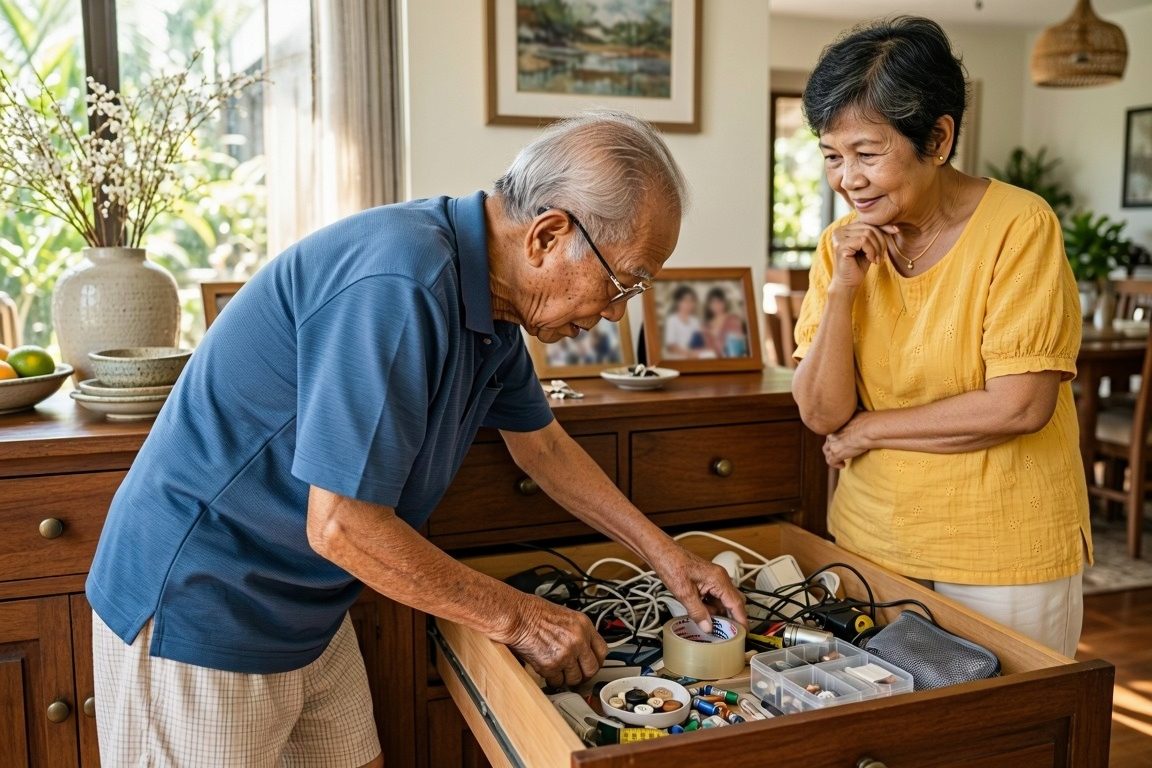
Clutter-Free Zone Checklist
Create a simple checklist for each room:
Review weekly.
Nightlights with Motion Sensors
Install motion-activated nightlights in hallways, bathrooms, and the bedroom. Choose lights with a warm, soft glow to avoid glare. This helps your loved one navigate at night without confusion or falls. Avoid lights that flicker or change color, as these can be disorienting.
Large-Print and High-Contrast Reading Aids
Use large-print books or a magnifying sheet. Place a piece of brightly colored paper (e.g., yellow or red) under the line being read to help track text. A reading lamp with a flexible arm can reduce shadows. For puzzles or games, choose those with large, high-contrast pieces.
Visual Cue Cards for Daily Tasks
Create simple picture cards showing steps for tasks like washing hands or brushing teeth. Use high-contrast images (e.g., a black-and-white drawing of a toothbrush). Place the card in the bathroom near the sink. This provides a visual reminder that is easier for the brain to process than a verbal instruction.
Different situations
Lewy Body Dementia (LBD)
Visual hallucinations are common in LBD, and visual processing problems may be more severe and fluctuating. Be extra cautious with lighting and patterns, as they can trigger hallucinations. Use simple, solid colors. If hallucinations occur, do not argue, gently redirect to a different activity. Discuss any new visual symptoms with their neurologist, as they may need medication adjustments.
Late-Stage Dementia
In late stages, visual processing may be severely impaired. Focus on safety: remove tripping hazards, use bed rails or floor mats, and ensure the environment is calm and predictable. Use high-contrast tape on the edges of steps or doorways. Verbal cues become even more important, describe everything you are doing. At this stage, the goal is comfort and dignity, not independence.
Spouse vs. Adult Child Caregiver
A spouse may be more attuned to subtle changes in their partner's visual abilities, but may also be more emotionally invested and reluctant to restrict driving or other activities. An adult child may have an easier time making objective decisions but may need to navigate family dynamics. Both should seek support groups specific to their role. Spouses may benefit from respite care to manage the emotional toll, while adult children may need help balancing caregiving with work and family.
In a Facility (Assisted Living or Memory Care)
Advocate for your loved one's visual needs with staff. Request that their room be kept clutter-free and that high-contrast items be used at meals. Ask staff to use verbal labeling when handing over items. Ensure that pathways to the dining room and bathroom are well-lit and free of obstacles. If your loved one is in a shared room, discuss with staff how to minimize visual confusion from the other resident's belongings.
Medicaid or Limited Resources
Many visual aids can be made with low-cost materials. Use colored construction paper to create high-contrast placemats or bookmarks. Repurpose brightly colored dish towels as contrast markers. Use free apps on a tablet for large-print reading or simple games. Contact your local Area Agency on Aging for low-cost or free home safety assessments. Some state programs offer assistance with home modifications for dementia safety.
For the doctor
6
- If your loved one has a sudden change in vision (e.g., double vision, loss of vision in one eye, or seeing flashes of light), seek immediate medical attention, this could be a stroke or other emergency.
- Ask their doctor about a comprehensive eye exam to rule out cataracts, glaucoma, or macular degeneration, which can compound visual processing problems.
- Discuss driving safety with their healthcare provider. Ask about a formal driving assessment through a rehabilitation center or the Department of Motor Vehicles.
- If visual hallucinations are present, especially in Lewy body dementia, ask about medication options (e.g., cholinesterase inhibitors) that may help, but never adjust medications without a doctor's guidance.
- Inquire about occupational therapy, which can provide personalized strategies for visual processing challenges, such as using contrast or simplifying tasks.
- If your loved one is on medications that affect vision (e.g., anticholinergics, certain antidepressants), ask their doctor if alternatives are available.